CambridgeIC’s CAM622 is a Resonant Inductive Encoder IC. It connects to a host device over SPI, quadrature ABN, BiSS or SENT interfaces.
The CAM622 connects to an external Type B Rotary Sensor or Type B Linear Sensor and detects the position of a contactless resonant inductive Type B Rotary Target or Type B Linear Target. Type B sensors and targets are made from PCBs. They include coil patterns for resonant inductive sensing. The coil patterns are available from CambridgeIC, so customers can manufacture the parts themselves and integrate them with their product. The CAM622 works with a variety of different sensor and target sizes.
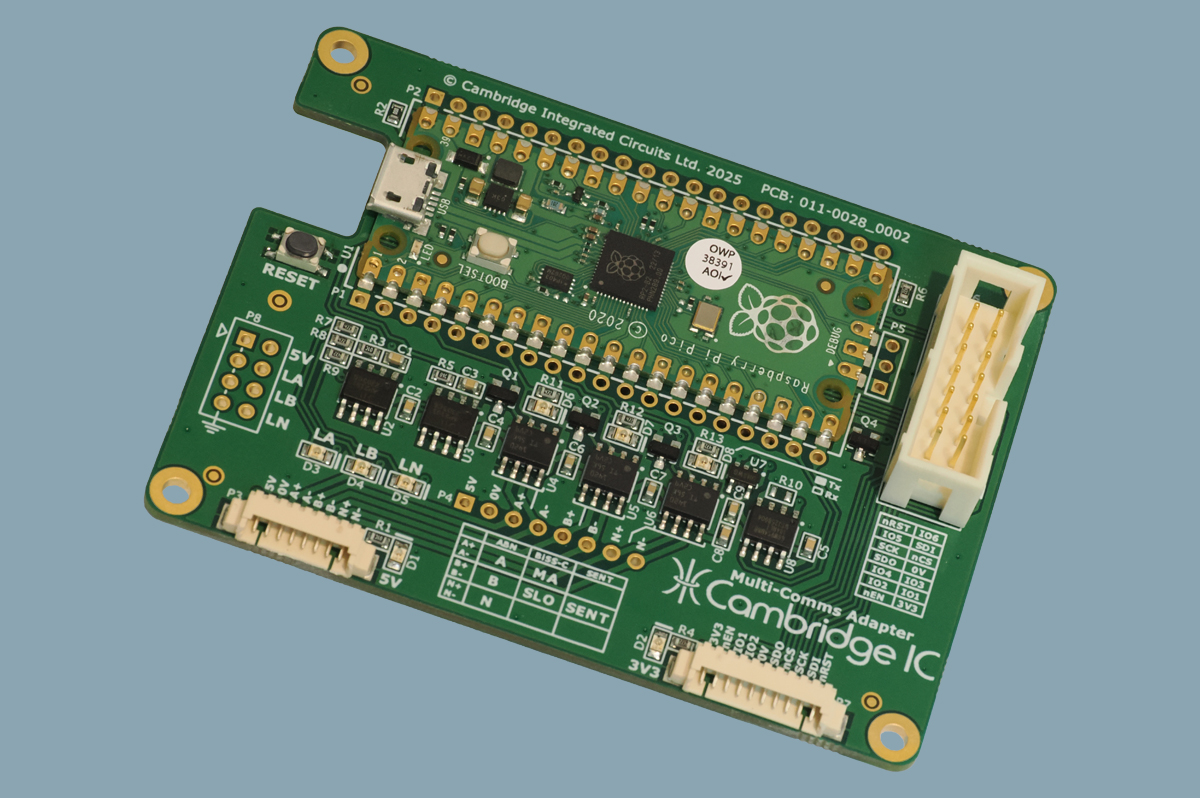
The CAM622 can generate encoder style quadrature digital outputs with reference pulse ("quadrature ABN"). The CAM622's True Edge Timing ensures that ABN edges emulate those generated by an ideal optical encoder. The ABN interface is fully programmable over SPI or BiSS, and the CAM622 includes non-volatile memory to store its configuration for standalone operation. CambridgeIC's MultiComms Adapter may be used for programming. It connects between the CAM622's SPI and a PC's USB port. A CAM622 Configuration Tool is available to run on a PC.
A host may alternatively use SPI or BiSS as the primary interface, reading measurement results at high speed. For BiSS, the CAM622 works together with an external iC-MB part available from iC-Haus.
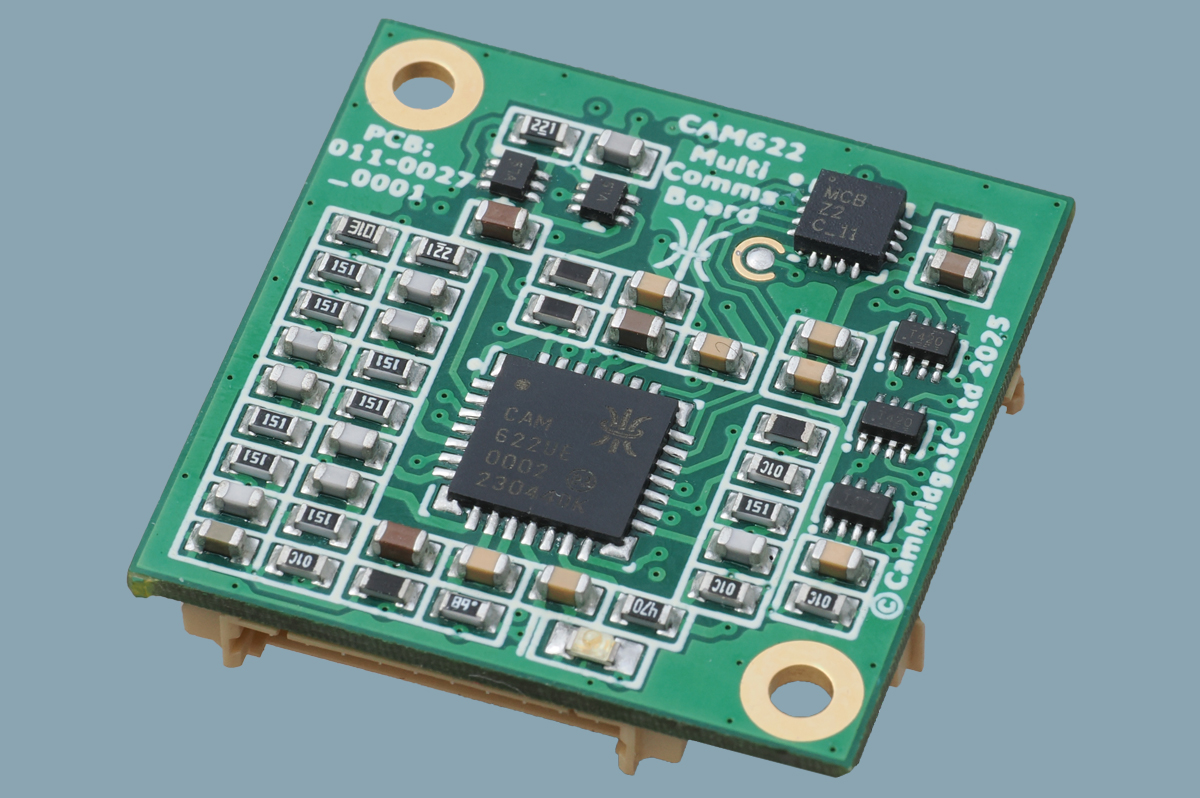
A CAM622 MultiComms Board is available for customer evaluation and prototyping. For initial evaluation it is recommended to purchase this as part of the CAM622 MultiComms Bundle.