Linear Motor Control

Type B Linear Sensors with CAM622 processing make a good fit for linear motor position feedback.

CambridgeIC’s CAM622 processor IC is suited to linear motor control when used with Type B Linear Sensors:

  • Enable precise and efficient field oriented control: ≤±0.06mm linearity error without calibration or special alignment steps
  • High quality velocity feedback
  • Excellent low-velocity smoothness due to 16 bits of noise free resolution
  • Operates at up to 60m/s
  • Sensing dynamics are indistinguishable from an optical encoder due to delay compensation and adaptive filtering
  • No magnets
  • Simple to mount e.g. with screws
  • Tolerant of misalignments
  • Tolerant of dirt and dust, no optical elements to foul
  • Interface options suited to motor controllers
    • BiSS
    • Quadrature digital (ABN) with edge resolution configurable down to 2µm depending on measuring length
    • SPI
  • Supports a wide range of motor types and pole counts, due to…
    • Different sensor sizes available, see Type B Linear Sensors for the current range
    • Absolute position output, supporting commutation for any motor pole pair distance

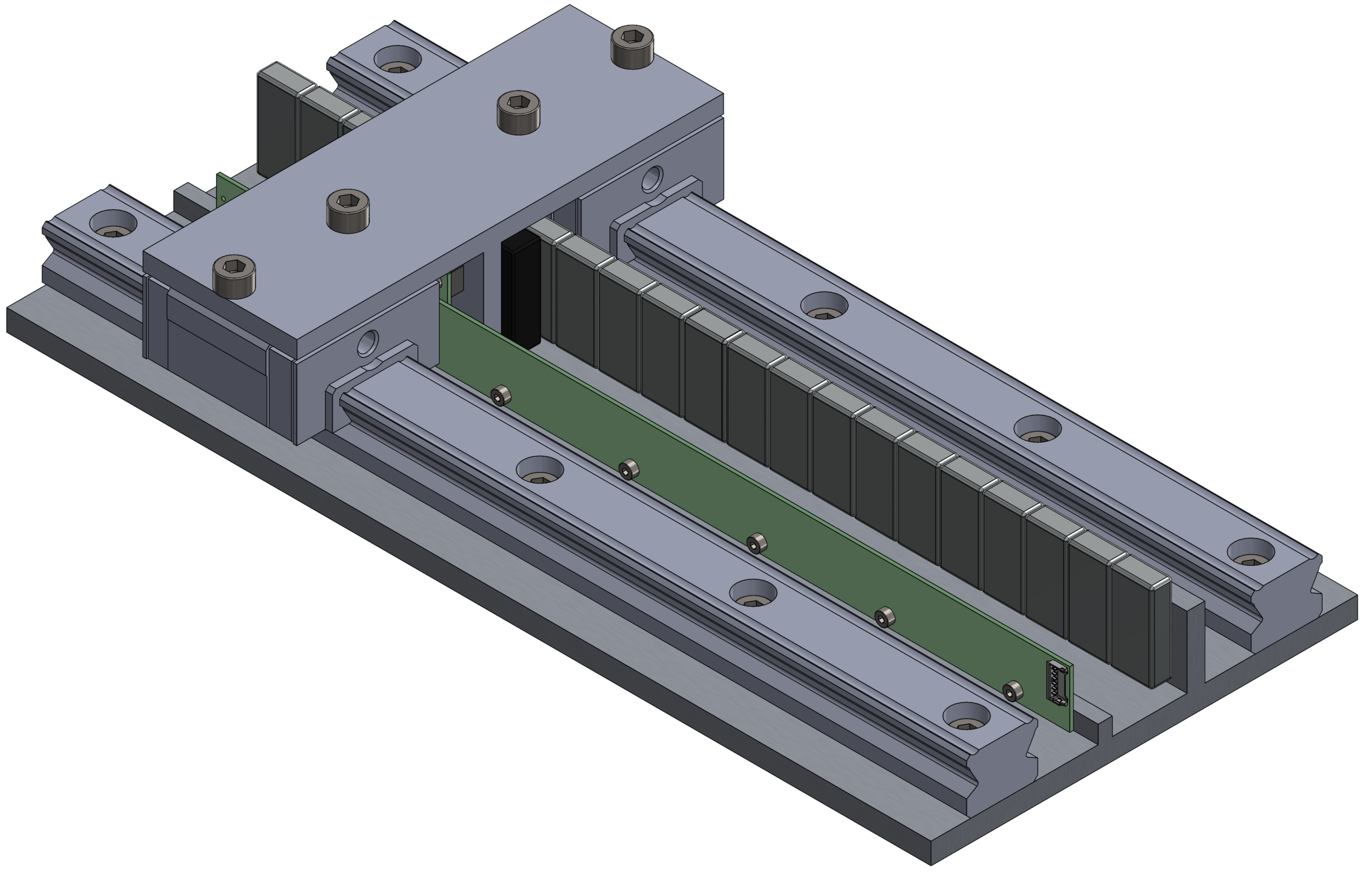
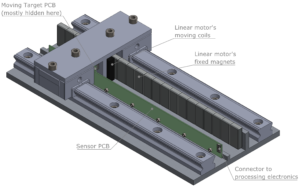
The video below illustrates the 200mm B12 Linear Sensor and its matching target used in a linear motor application.

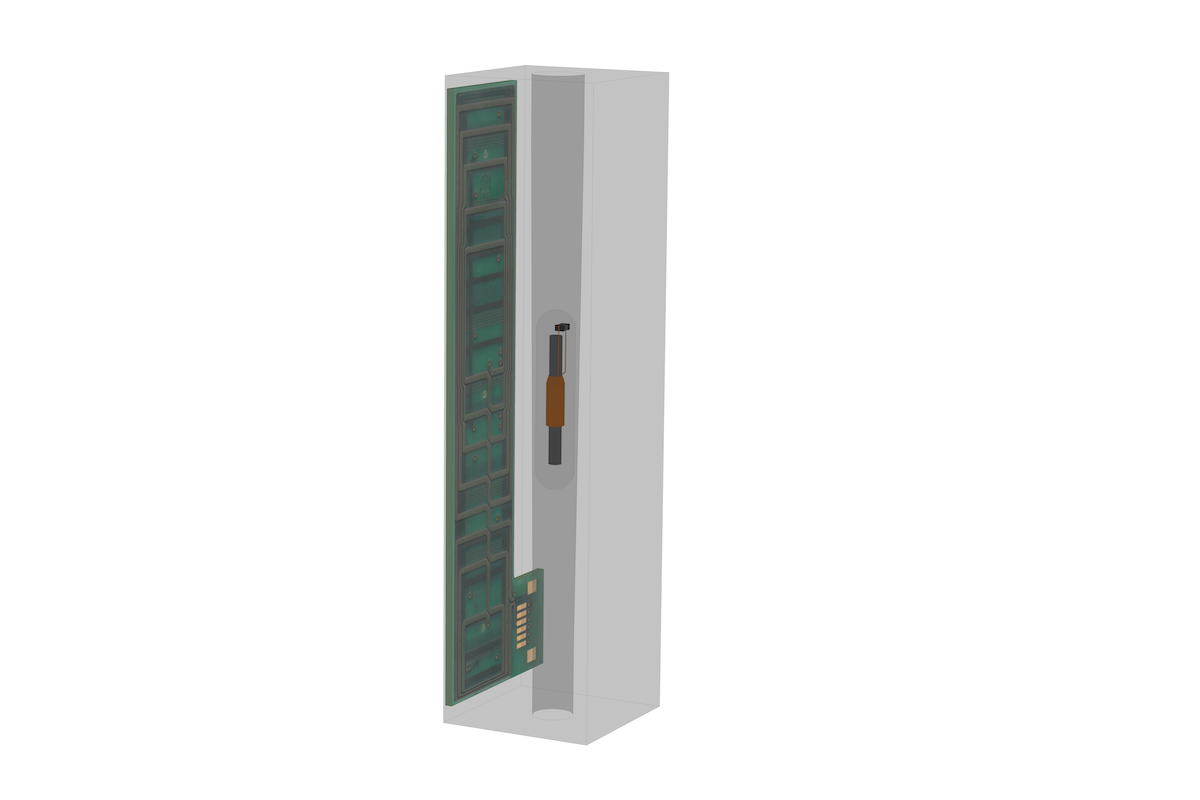
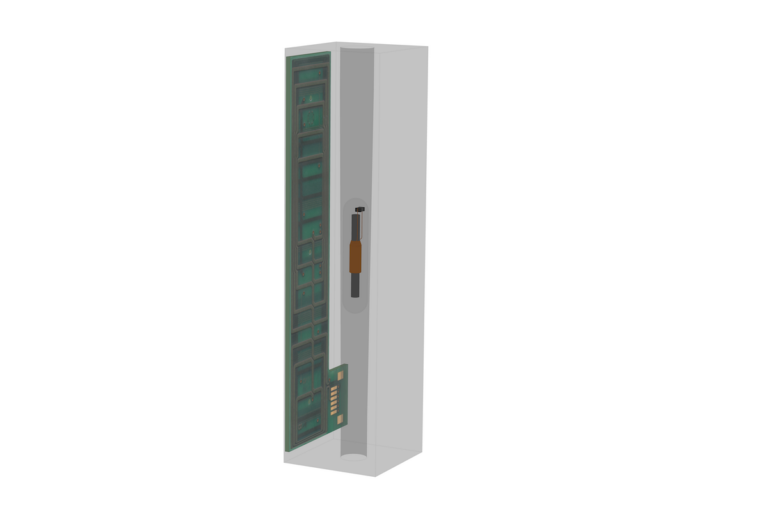
The figure below illustrates the components of this system.
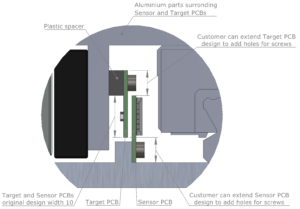
The figure below shows the sensor and target PCBs end on, to illustrate a possible mounting scheme using screws.  CambridgeIC’s linear sensor and target designs are typically 10mm wide, and the customer can extend their board outlines as illustrated below to accommodate screw holes.
Linear motors with CAM622 based feedback find applications across many industries including Medical, Industrial Automation, Automotive, Marine and Submarine.
Linear Actuator

Ballscrews are often used to convert the rotary motion of a motor to linear motion.  Historically position feedback has been taken from the motor due to the relative convenience and low cost of rotary encoders compared to linear, especially absolute linear ones.

The problem with this arrangement is that the encoder is not measuring the point of load, so any backlash or other errors in the drive train are not corrected inside the servo loop.  Instead designers have to over engineer the ballscrew for low backlash and precision.

CambridgeIC’s CAM622 processor IC paired with Type B Linear Sensors upends this logic.  By positioning a low-cost, absolute, precise linear sensor at the point of load, there is no longer a need for such a precise drivetrain.  Furthermore any rotary encoder still needed on the motor need only be the more cost effective single-turn type, for example CambridgeIC’s solution.

Unlike optical and magnetic encoders the sensor is the longer, fixed part and the target is the contactless and wireless part.  This means that the design does not require the management of moving cables running between the moving part and stationary processing electronics, further reducing cost and complexity.

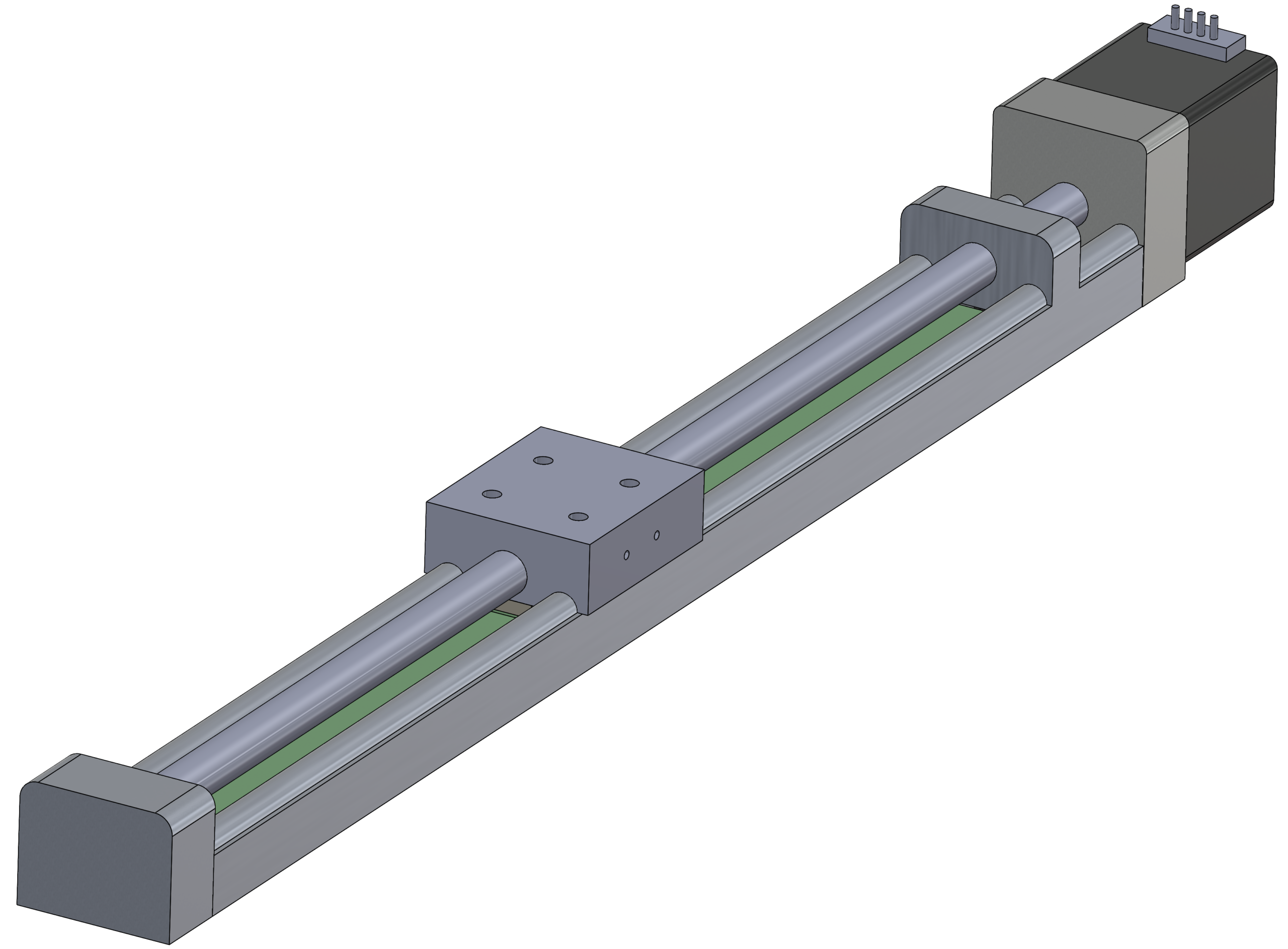
The video below illustrates how a 200mm B12 Linear Sensor may be integrated with a ballscrew driven linear slide system.


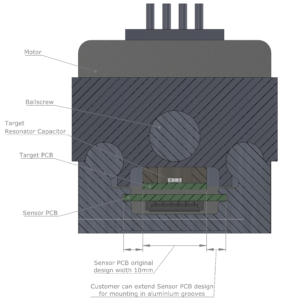
The figure below shows how the sensor and target may be arranged inside an aluminium extrusion.  CambridgeIC’s linear sensor designs are typically 10mm wide, but here the board edges have been extended to the left and right so they engage with slots in the extrusion.  Mounting the sensor in slots like this is simple and cost effective.

This style of linear feedback using the CAM622 finds applications across many industries including Medical, Industrial Automation, Automotive and Marine and Submarine.
Dial Reading

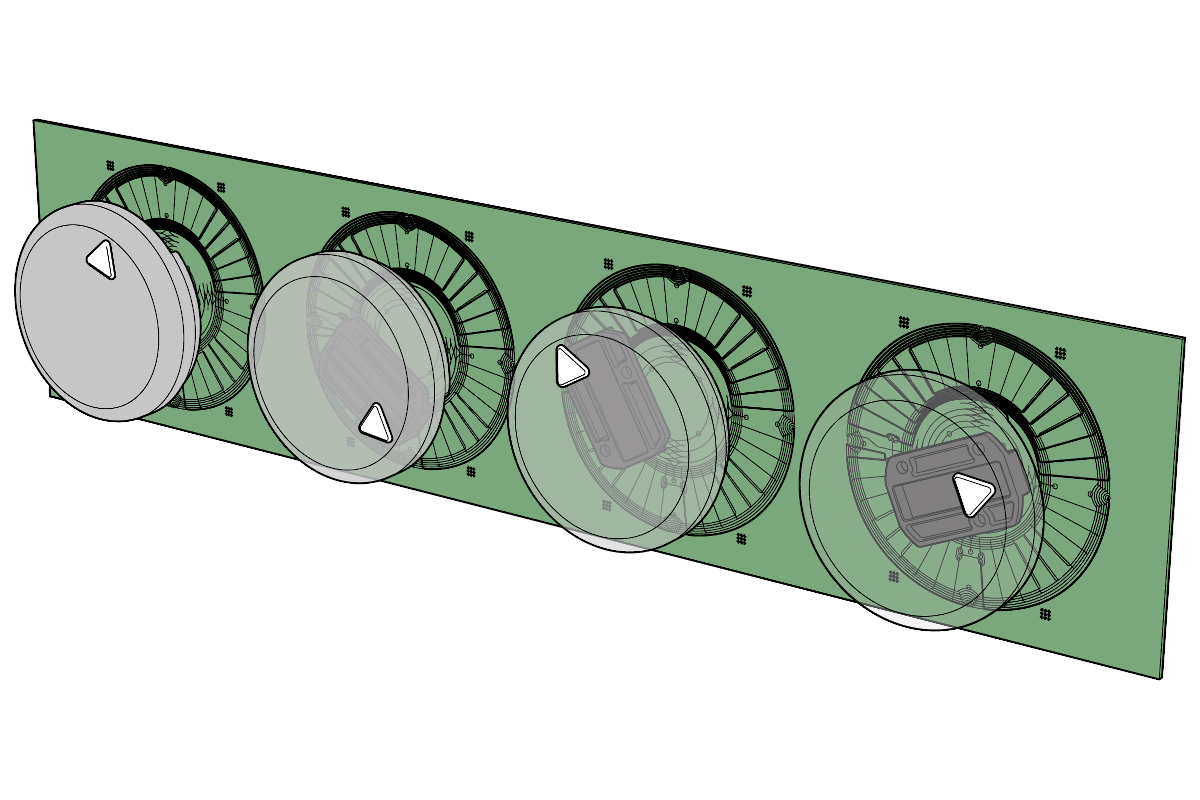
CambridgeIC's largest Basic Rotary Sensors sense angle without contact, with large gaps allowed.  This means they can be separated by thick plastic panels, helping product designers achieve the look and feel they need with a minimum of mechanical complexity.

CambridgeIC’s largest Basic Rotary Sensors sense angle without contact, with large gaps between the sensor and target.  This means they can be separated by thick plastic panels, helping product designers achieve the look and feel they need with a minimum of mechanical complexity.

Using CambridgeIC’s solution means no contact between sensor and targets and the dials and readers may be housed in separate modules.  So, for example, a fixed reader can read multiple sets of dials as they move round a production process, and each set of dials can be read by multiple readers at different points in the process.

  • Rotary sensors read dial angles
  • Large gaps possible (11mm with 50mm basic rotary sensor)
  • Tolerant to radial misalignment (2mm with 50mm basic rotary sensor)
  • Up to 24 settings per dial for a robust system
  • A single CAM204 chip supports up to 4 dials (or 16 with external mux components)
  • Immune to dirt and moisture
  • Simple and robust
alt

Multi Axis Sensing

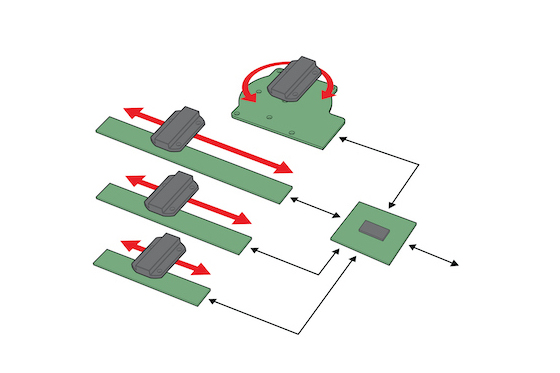
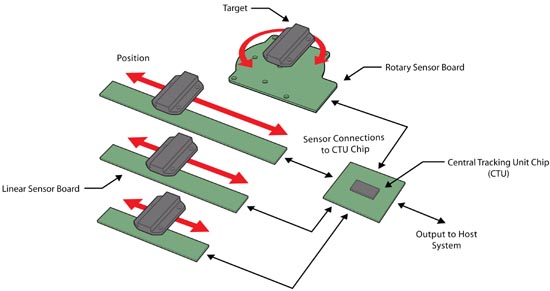
The CAM312 and CAM204 Central Tracking Unit (CTU) ICs can work with multiple sensors, each built from conventional low-cost PCBs.

The CAM312 and CAM204 Central Tracking Unit (CTU) ICs can work with multiple sensors, each built from conventional low-cost PCBs.

Used with a simple target, this delivers a particularly cost effective solution for machines that require multi-axis systems.

alt
Centralising the position processing in a CTU chip also means that there is a single source of position feedback for the host, rather than the network of connections required for a traditional multi-axis system.

The number of sensors supported by a CTU chip depends on the CTU and sensor type.  For example, the CAM204 CTU chip supports 4 basic sensors (Type 1 circuitry), and the CAM312 supports 2 basic sensors (Type 4 circuitry).  This number may be extended further with additional multiplexing circuitry.  Please contact CambridgeIC for details.

A single CAM622 IC does not support multiple sensors.  However for multi-axis applications it is possible to connect multiple CAM622 devices to the same SPI bus.

Float Level

Resonant inductive position sensing works through liquids and non-metallic housings to sense the location of a target.

Resonant inductive position sensing works through liquids and non-metallic housings to sense the location of a target.

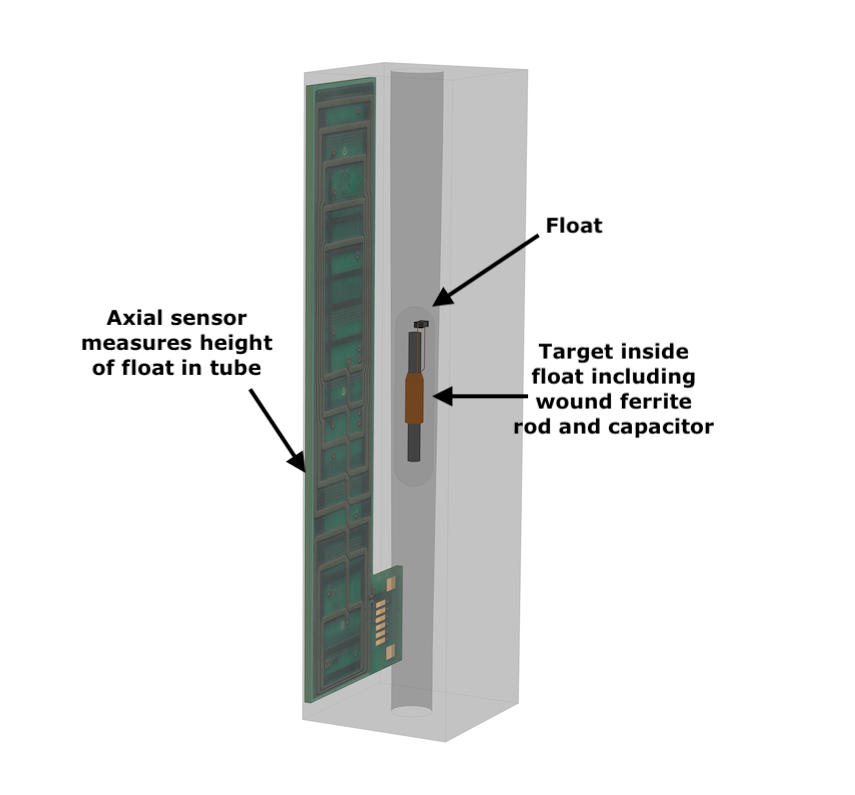
FloatLevelSystem2020 05 26C with labels

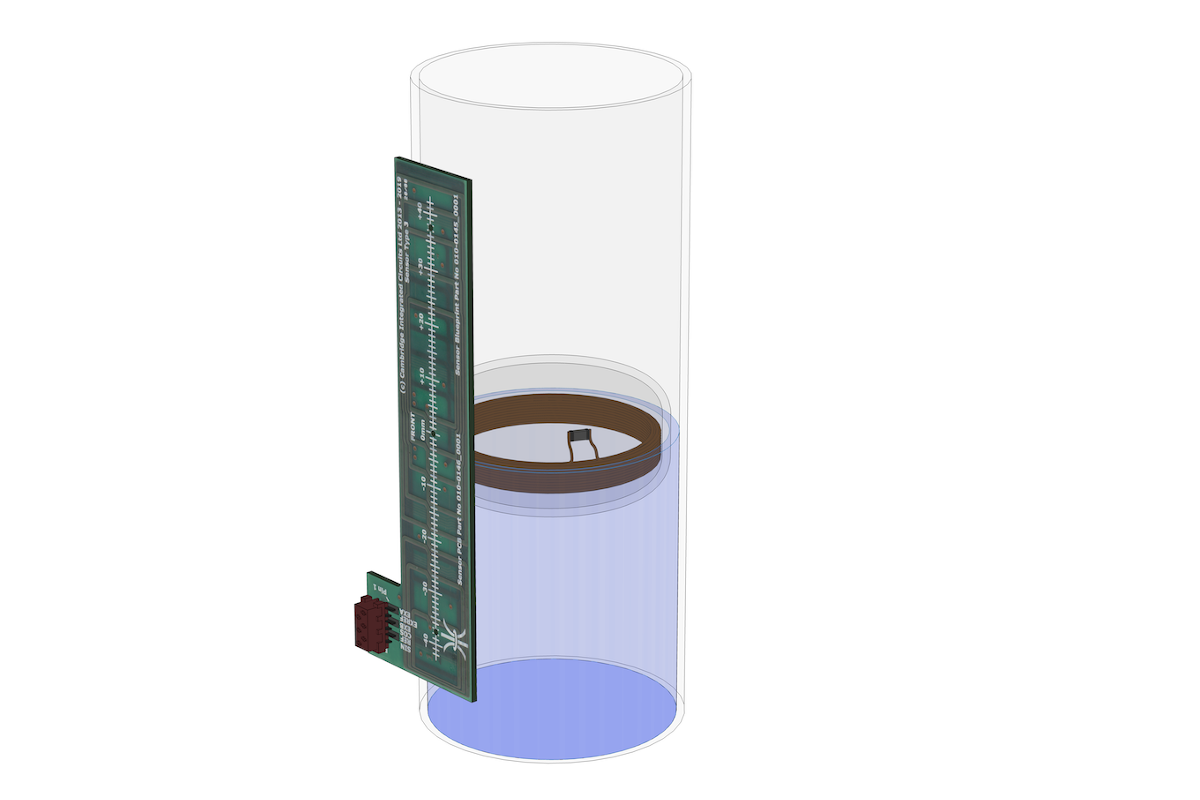
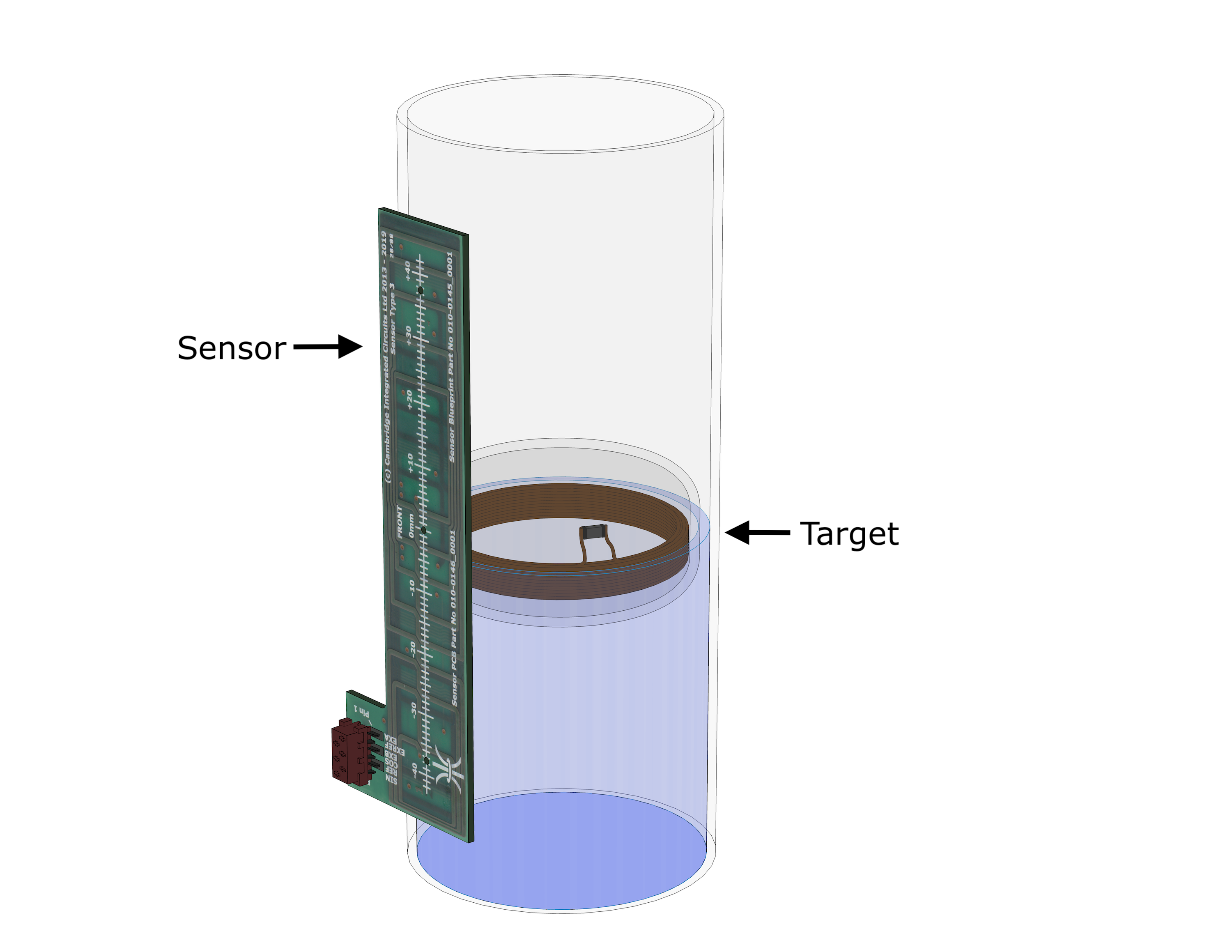
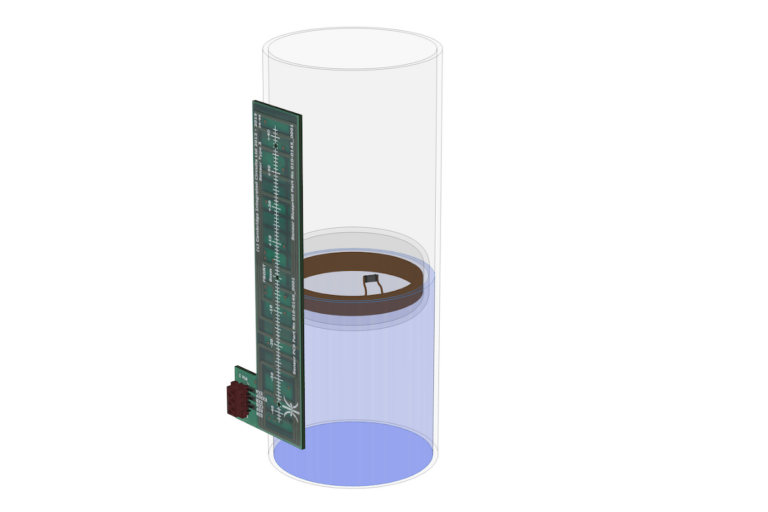
To sense liquid level, a resonator is embedded in a float, which acts as the target.

A sensor is placed outside the float chamber, and is connected to processing electronics based on the CAM312 chip.  To allow the float to rotate freely about its vertical axis, an Axial sensor is used.

  • Precise and stable measurement
  • The float is free to rotate
  • Senses float from outside float chamber
  • Sensor not in contact with liquid
  • Simple and robust

See how the axial sensing technology can be applied to liquid level sensing in the video below:

Measuring Thickness

Short Stroke sensors offer a convenient, cost effective method of measuring material thickness.

Short Stroke sensors offer a convenient, cost effective method of measuring material thickness.

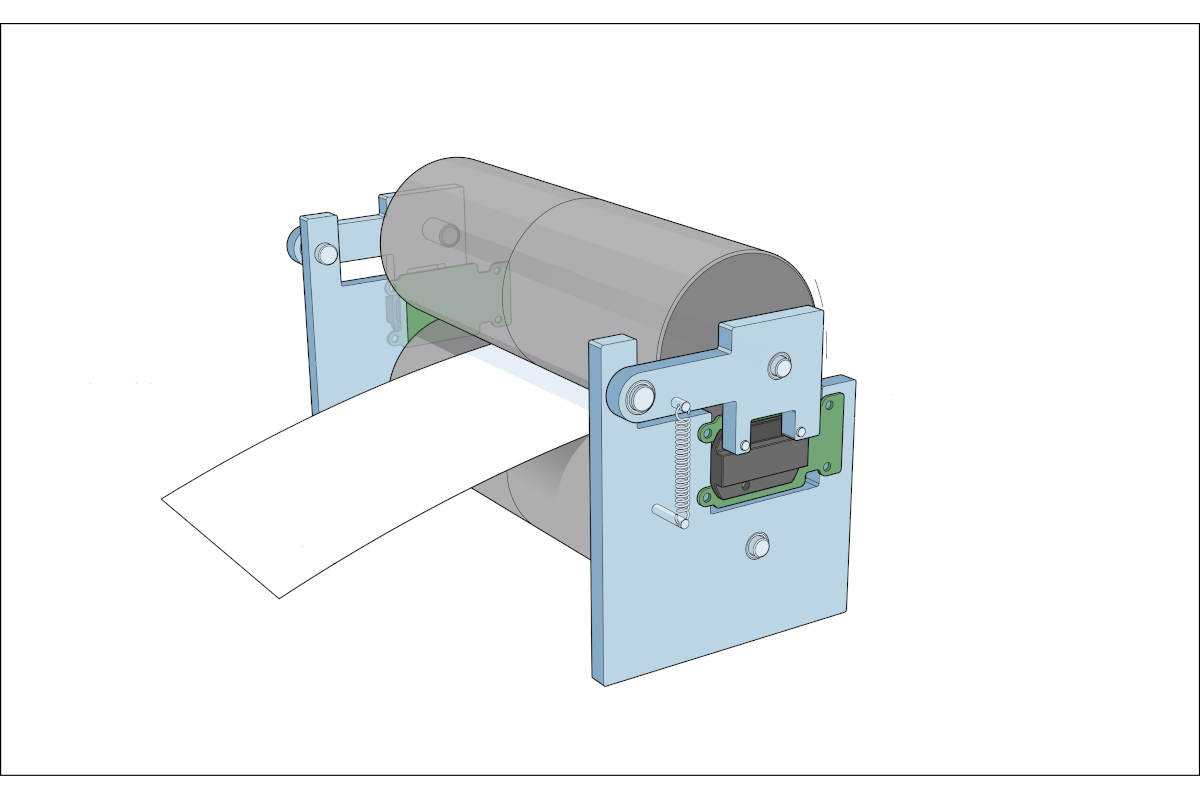
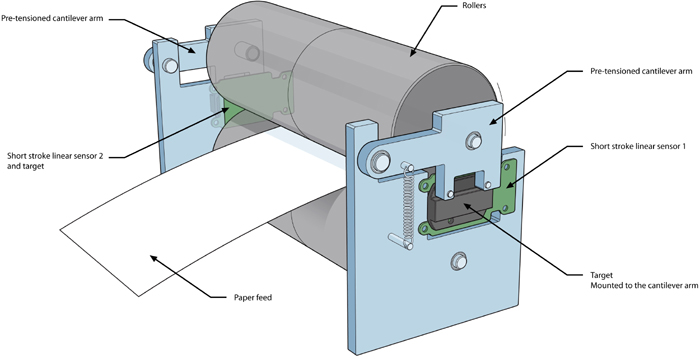
For example when measuring the separation between rollers, paper is fed through rollers that are sprung together with cantilever arms at each end to follow the paper’s thickness profile.  The displacement of each cantilever is measured by a sensor and its target.

Key features of this system include:

  • Non-contact measurement
  • Short stroke sensors measure linear displacement but also tolerate the angular displacement of the cantilever arms
  • Independent measurement of the displacement at each end of the rollers
    • Average displacement yields thickness measurement at centre of rollers
    • Difference in displacement yields roller angle, for example due to folded paper
  • Sensors are insensitive to lateral misalignment and wobble
  • Sensors require only 3 wire connections
  • A single CAM312 IC measures both sensors to ~ 5µm Noise Free Resolution
  • Immune to dirt and moisture
  • Simple and robust

Short Stroke sensor measures material thicknessbetween rollers

Short Stroke sensors are similar to LVDTs in operating principle, but are more compact, simpler and cost effective.  Unlike Hall Effect sensors, they are not disturbed by stray magnetic fields and do not require special magnets and precise alignment.

For higher speeds and resolution the CAM622 and a 40mm B6 Linear Sensor may be used in place of the CAM312 and a Short Stroke Sensor.

Arc Position

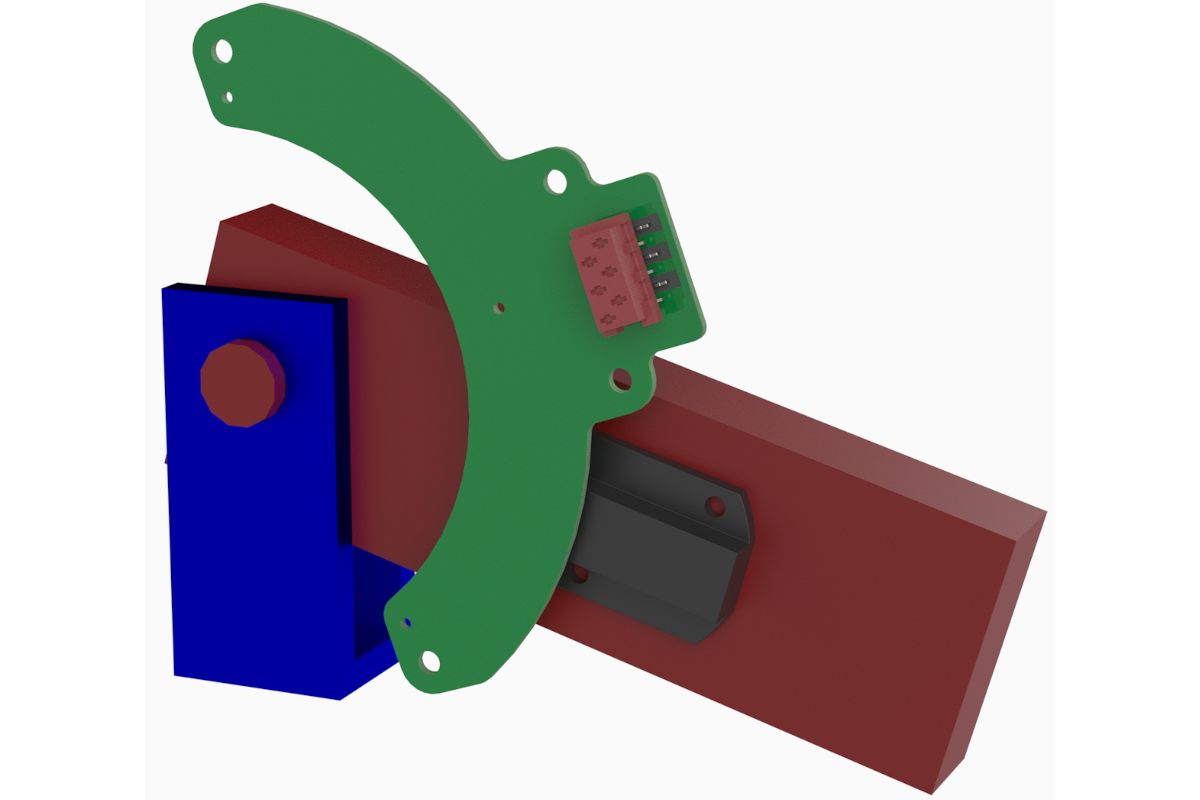
Arc Position Sensors from CambridgeIC measure the angle of a rotating target relative to a fixed sensor.

Measure the angle of a rotating target — without putting anything on the axis.

Arc Position Sensors from CambridgeIC measure the angle of a rotating target relative to a fixed sensor.

They are positioned off-axis, so that the rotation axis is free from sensor parts and any couplings. Arc sensors only extend along the measurement range of interest, so a complete sensor ring around the axis is not needed.

CambridgeIC Arc Position Sensors…

  • Directly measure arc angle
  • Eliminate mechanisms, bearings and couplings
  • Sense off-axis – the rotation axis is clear of sensor parts
  • Enable a large gap between sensor and target
  • Are truly non-contacting
  • Are robust against mechanical shock
  • Are tolerant of misalignment
  • Are lightweight
  • Can be completely encapsulated against dirt, dust, moisture
  • Can be used in pairs, connected to a single CAM312 CTU processor chip
  • Can be designed for the newer CAM622, please contact us.
  • Can be manufactured by the customer, for a cost effective solution that is well integrated with the customer’s product

Where arc sensors are used

Surveillance cameras

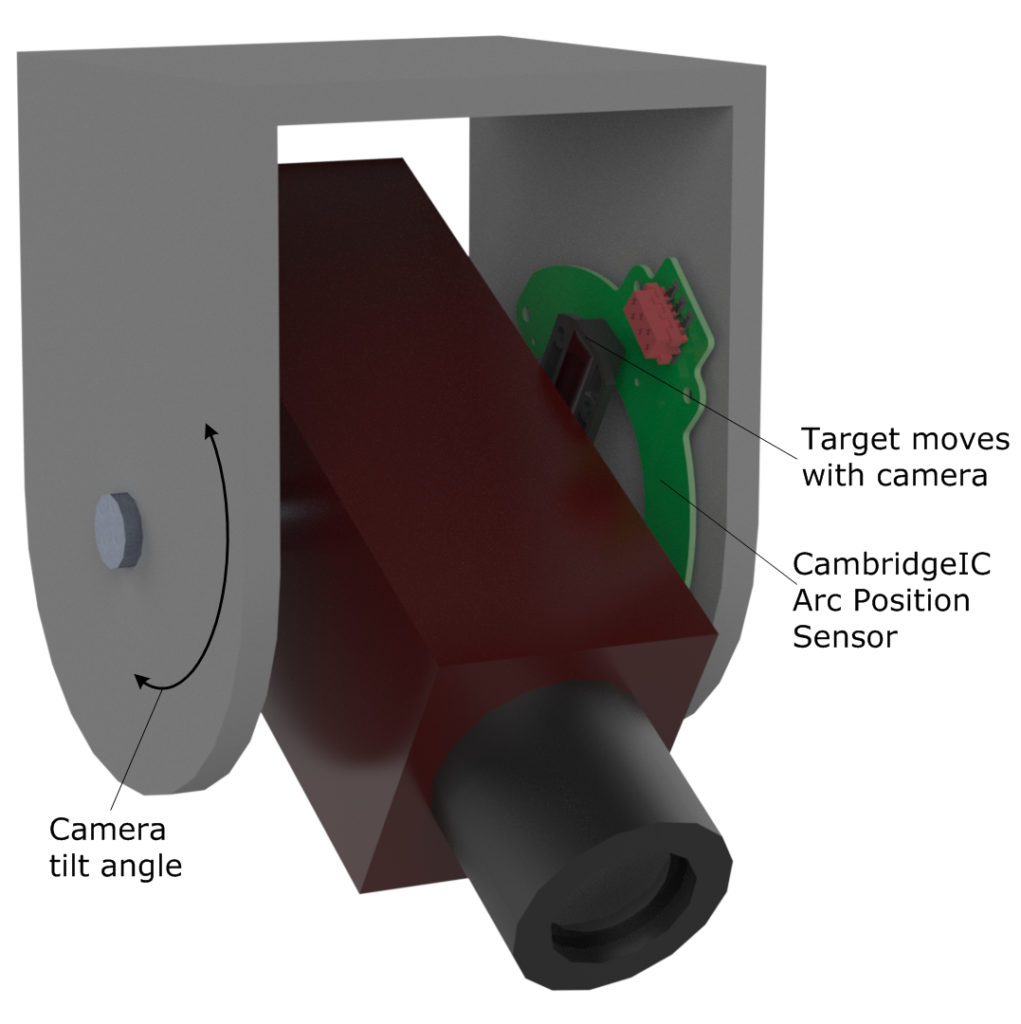
Motorised surveillance cameras including PTZ cameras often have a tilt axis with limited angle range, for example 90° or 180°. Angle sensors measuring pan and tilt angle help the camera’s control system to point the camera in the desired direction, and to track objects moving in the camera field. An arc sensor helps to simplify the camera’s mechanics, because it can be positioned off-axis and does not need precise alignment. Since the sensor only measures the 90° or 180° angle range needed by the application, it can be more compact than a conventional 360° sensor and delivers higher resolution as a fraction of the actual measuring range needed.

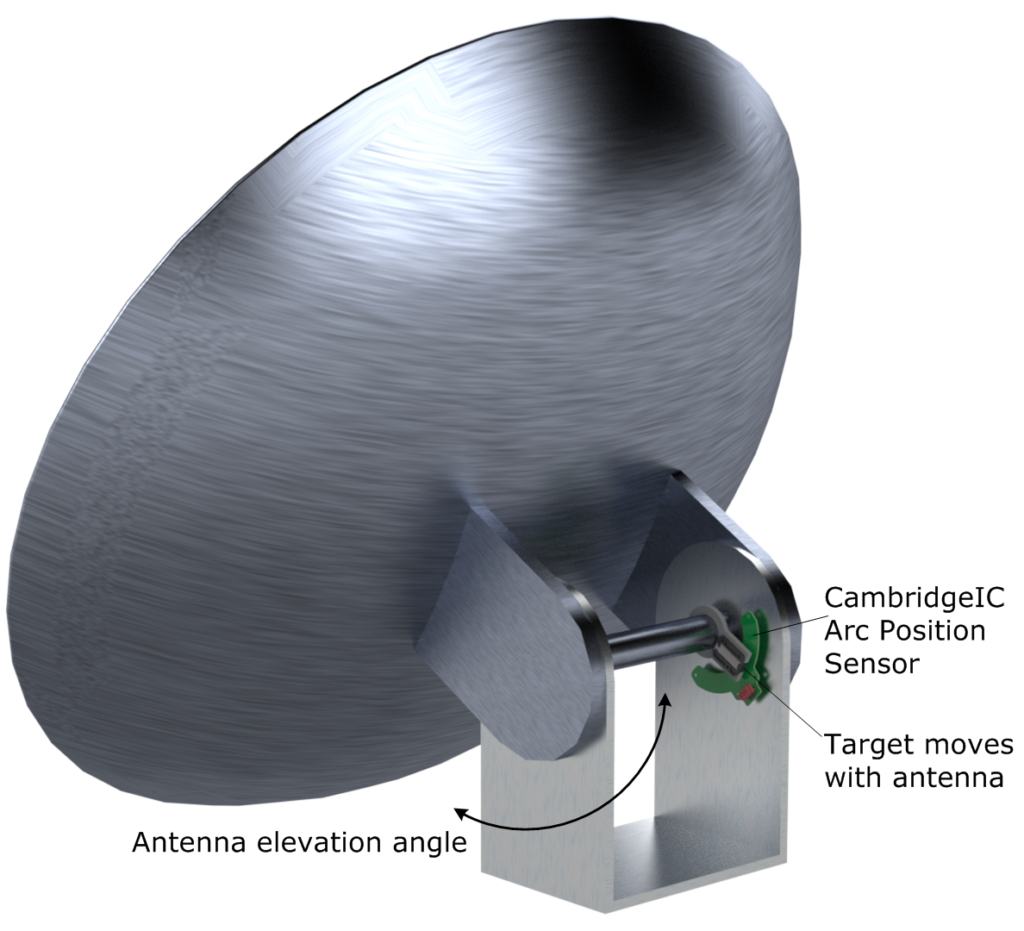
Target moves with antenna; the sensor measures antenna elevation angle.

Motorised antennas

Motorised antennas are used for communications applications including mobile point to point and satellite communication and mobile satellite TV reception. Angle sensors on the elevation axis help the antenna’s control system point in the right direction.

Like a surveillance camera tilt axis, an antenna’s elevation axis usually has limited angle range, and a CambridgeIC Arc Position Sensor can be a space efficient and mechanically convenient sensor solution.

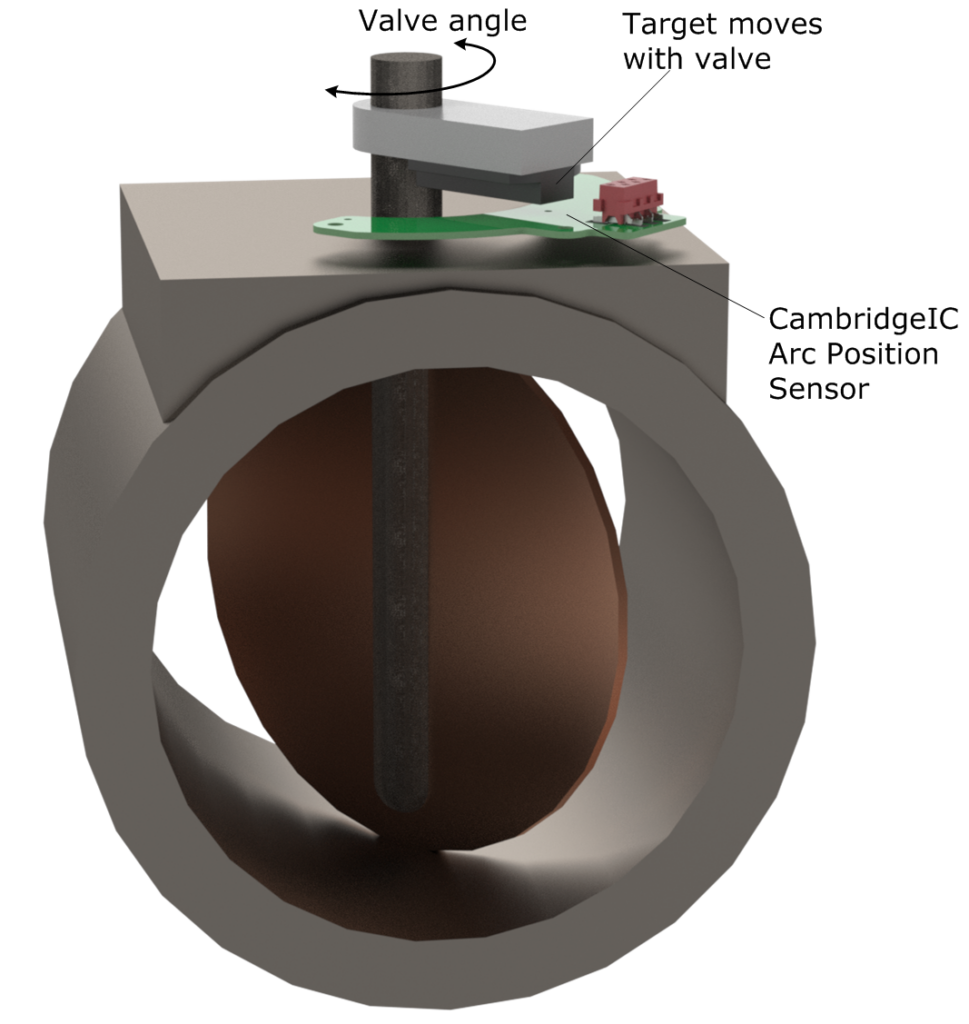
Target moves with valve; the sensor measures valve angle through the housing.

Intelligent valves

Intelligent valves control fluid flow, driven by an electrical motor, pneumatic or hydraulic power. They often include a butterfly valve with 90° angular movement. The control system usually requires angular position feedback, to ensure the valve is set to the correct angle.

A CambridgeIC Arc Position Sensor can precisely measure the full absolute angle of a butterfly valve. It can be positioned inside the control enclosure, or independently sealed for immunity to the harsh chemical and mechanical environment.

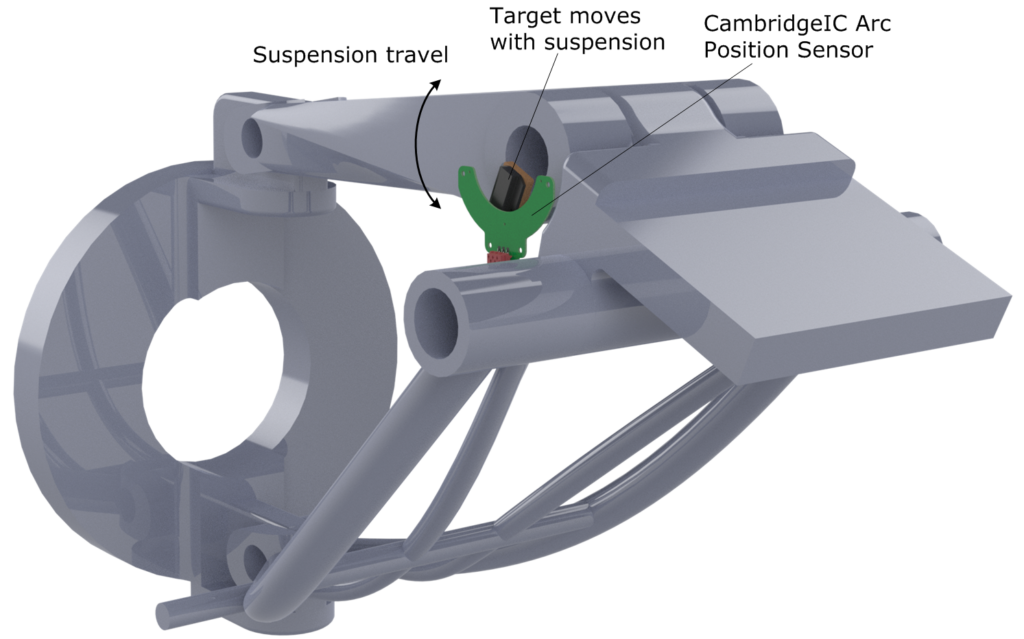
Target moves with suspension; the sensor measures suspension travel directly.

Suspension level

Suspension level sensors help a vehicle measure and sometimes control its suspension level. Applications include load measurement, self-levelling and dynamic active suspension control in off-road vehicles, trucks, all-terrain vehicles and motorsport.

CambridgeIC Arc Position Sensors directly measure suspension displacement. They do not need the linkages typically used to adapt linear and rotary sensors for the task, illustrated under “Arc Sensor Applications” on the technology comparison page.

Other applications include…

Pan and Tilt

CambridgeIC has over 14 years' experience working with pan/tilt surveillance camera designers, delivering leading performance and a cost effective, convenient feedback solution.

Read more Pan and Tilt

Float Level

Resonant inductive position sensing works through liquids and non-metallic housings to sense the location of a target.

Read more Float Level

Variable Area Flow Meter

Resonant inductive position sensing works through fluids and non-metallic housings to sense the location of a target.

Read more Variable Area Flow Meter

Variable Area Flow Meter

Resonant inductive position sensing works through fluids and non-metallic housings to sense the location of a target.

Resonant inductive position sensing works through fluids and non-metallic housings to sense the location of a target.

FlowMeter2020 05 19A4 with labels

To sense liquid flow in a variable area flow meter, a resonator is embedded in a float, which acts as the target.

A sensor is placed outside the float chamber, and is connected to processing electronics based on the CAM312 chip.  To allow the float to rotate freely about its vertical axis, an Axial sensor is used.

  • Precise and stable measurement
  • The float is free to rotate
  • Senses float from outside float chamber
  • Sensor not in contact with liquid
  • Simple and robust

See how the axial sensing technology can be applied to the electronic reading of variable area flow meters in the video below:

Pan and Tilt

CambridgeIC has over 14 years' experience working with pan/tilt surveillance camera designers, delivering leading performance and a cost effective, convenient feedback solution.

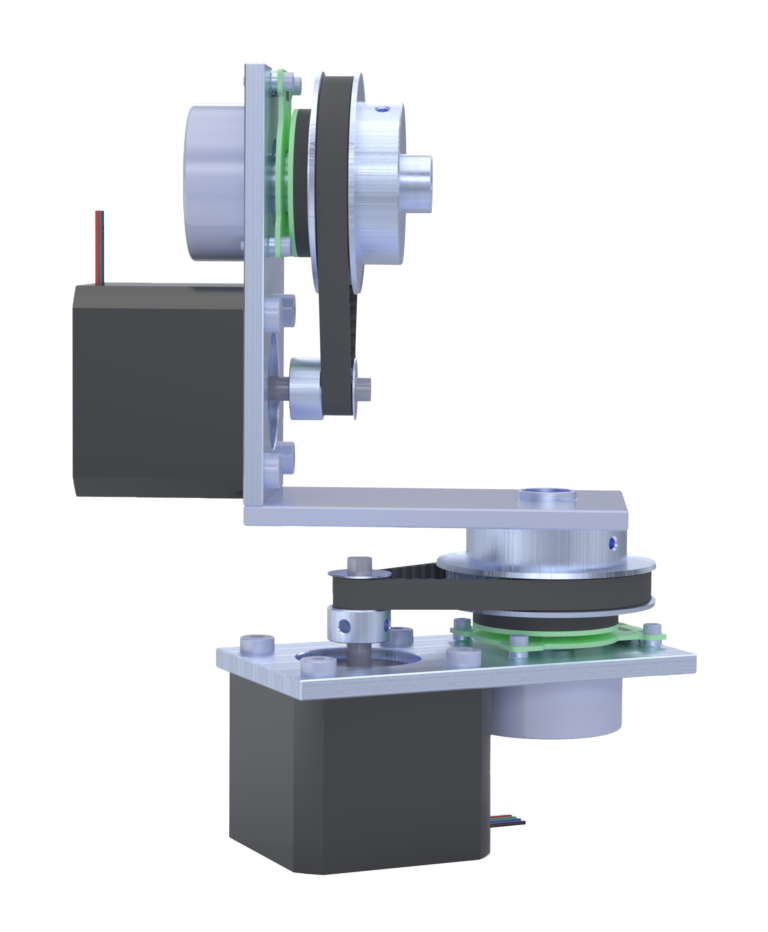
CambridgeIC’s sensors are used for measuring pan and tilt angles inside surveillance cameras, including at CambridgeIC’s customer Bosch (now Keenfinity).

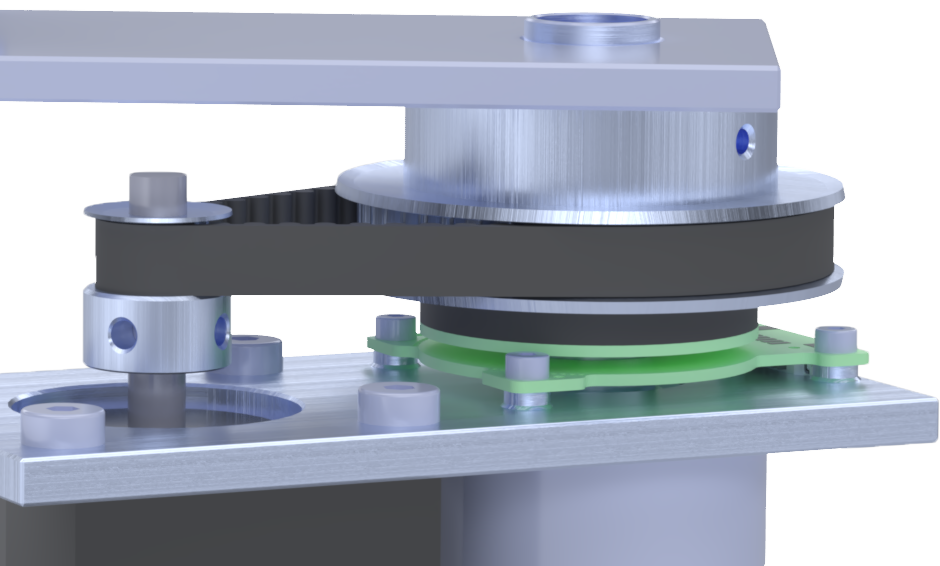
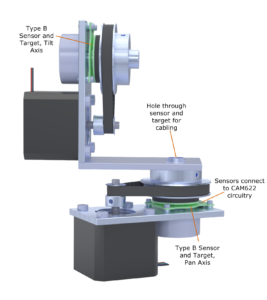
Type B Rotary Sensors working with Type B Rotary Targets and CAM622 circuitry are recommended in new applications. Key features of the solution include:

  • Truly non-contacting, typical operating gap 1.0mm ±0.5mm
  • Through-shaft: a hole in the middle of the sensor and target allows a shaft and cabling to pass through for measurement at the point of load
  • Highly tolerant of gap change and radial misalignment between sensor and target
  • Robust against mechanical shock
  • Stable across temperature
  • The customer can build sensors and targets themselves using conventional PCB fabrication and assembly
  • 16 bits noise free resolution with 30mm B3 Rotary Sensor
  • SPI interface at up to 33,000 measurements per second, or encoder-like quadrature ABN signals

Our customers prefer resonant inductive sensors because they are easier to integrate than optical and magnetic encoders and they allow for much greater mechanical installation tolerances.  They also find it more economical to buy and integrate CambridgeIC processing chips onto their existing processor board, because sensors can then be built by their own fab for the cost of a small and simple PCB.

Other applications for the pan and tilt sensing technology include:

  • Motion control of heliostat mirrors used to direct the sun’s rays on a collecting tower in Solar Thermal Power Stations
  • Mobile antenna platforms, where the antenna needs to remain pointing in the same direction when mounted to  a moving platform
  • Robotics for Medical and Industrial Automation applications

Motor Control

CambridgeIC's CAM622 processor IC is ideally suited to motor control applications requiring high quality position and velocity feedback.

CambridgeIC’s CAM622 processor IC is ideally suited to motor control applications requiring high quality position and velocity feedback:

  • Precise and efficient field oriented control: ≤±0.05° linearity error without calibration or special alignment steps
  • High quality velocity feedback
    • Differential non-linearity better than 1.5%
    • Minimal first harmonic position error even when misaligned, due to inherent balance of sensor and target designs
  • Excellent low-velocity smoothness due to ≥16 bits of noise free resolution
  • Operates at up to at least 66,000rpm
  • Sensing dynamics are indistinguishable from an optical encoder due to delay compensation and adaptive filtering
  • No magnets
  • Simple to mount e.g. with screws
  • Tolerant of axial play in motor shaft due to wide gap range
  • Tolerant of dirt and dust, no optical elements to foul
  • Interface options suited to motor controllers
    • BiSS
    • Quadrature digital (ABN) with configurable parameters including up to 65536 edges/rev
    • SPI
  • Supports a wide range of motor types and pole counts, due to…
    • Different sensor sizes available, see Type B Rotary Sensors for the current range
    • Absolute angle output, supporting commutation for any number of motor pole pairs

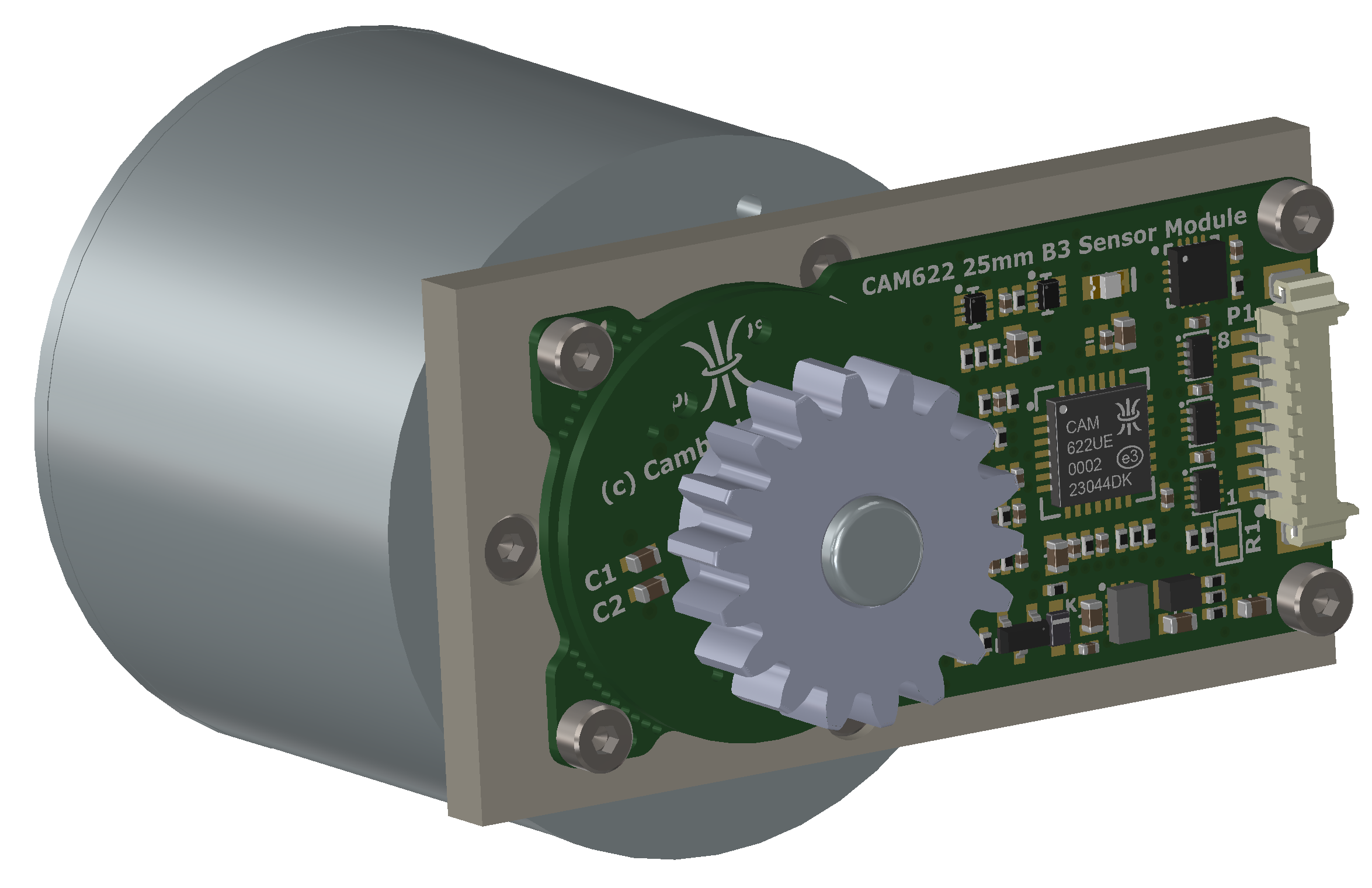
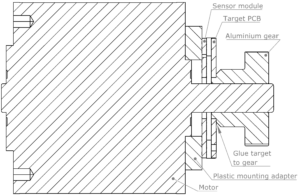
This video illustrates mounting to a Maxon ECi40-70W brushless DC motor.  Here the CAM622 and a 25mm B3 Sensor share the same PCB in a 25mm B3 Rotary Sensor Module.  This mounts to the motor’s fixing centres using a plastic adapter plate.

The matching 25mm B3 Target may be mounted directly to an aluminium gear wheel as illustrated in the video and below.  The two may be glued together, for example with epoxy.


The CAM622 finds applications across many industries including Medical, Industrial Automation, Automotive, in Pan and Tilt Surveillance Cameras and Marine and Submarine.