
Introduction
CambridgeIC has developed a range of proven standard sensors, including rotary and linear in different types and sizes. They are built using conventional printed circuit board (PCB) technology for low cost and simplicity. CambridgeIC supplies sensor designs to allow a customer to:
- Modify the board outline
- Add mounting holes or other features
- Change the connection scheme
- Combine sensors and other electronic circuitry on the same PCB
- Manufacture them cost effectively
Sensor and target samples are also available for sale, for customer evaluation and prototyping. See for example Type B Rotary Sensors, Type B Rotary Targets, Type B Linear Sensors and Type B Linear Targets.
Basic Sensors
Basic sensors comprise 3 coils:
- An Excitation Coil (“EX”) for powering the resonator inside the moving target
- A COS coil for detecting resonator signal, with coupling factor kCOS varying as the cosine of position
- A SIN coil for detecting resonator signal, with coupling factor kSIN varying as the sine of position
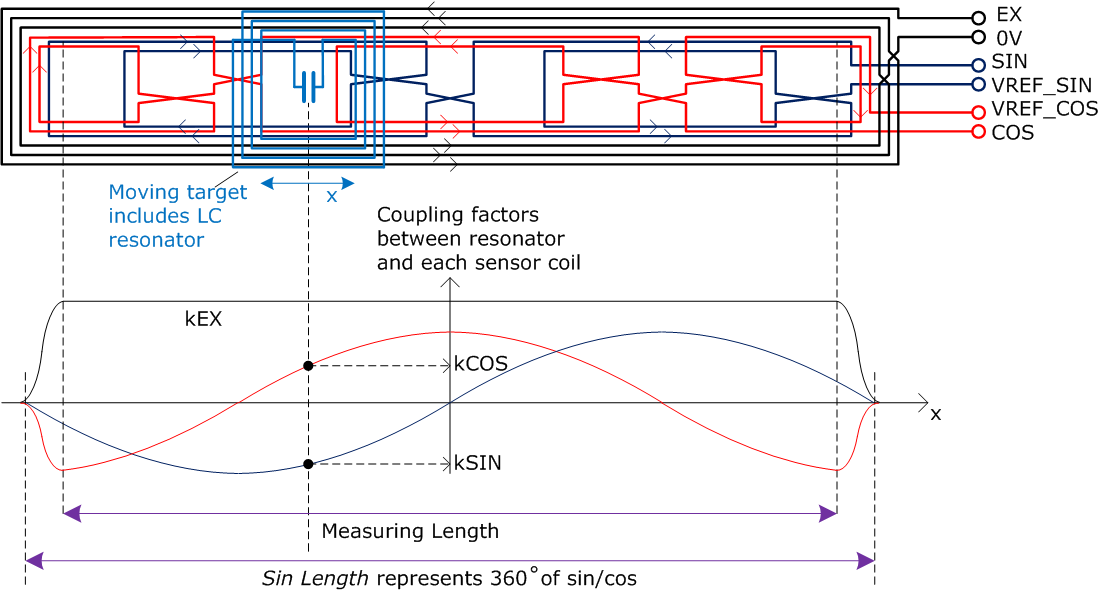
The sensor is connected to a processor IC and its circuitry, which performs interrogation and position calculation.
Note how the COS and SIN coils are balanced — they have portions wound in opposite directions — so that inductive interference cancels.
Basic Rotary and Basic Linear sensors are available for use with the CAM204 and CAM312 CTU processor ICs. When using the CAM204 up to 4 Basic Sensors may be connected using Type 1 circuitry. Alternatively when using either the CAM204 or CAM312 up to 2 Basic Sensors may be connected using Type 4 circuitry, including either one or two Short Stroke Linear sensors.
Basic Sensors are simple and cost effective, and typically replace potentiometers and on-axis magnetic sensors where the ultimate in accuracy and resolution isn’t required.
Precision Sensors
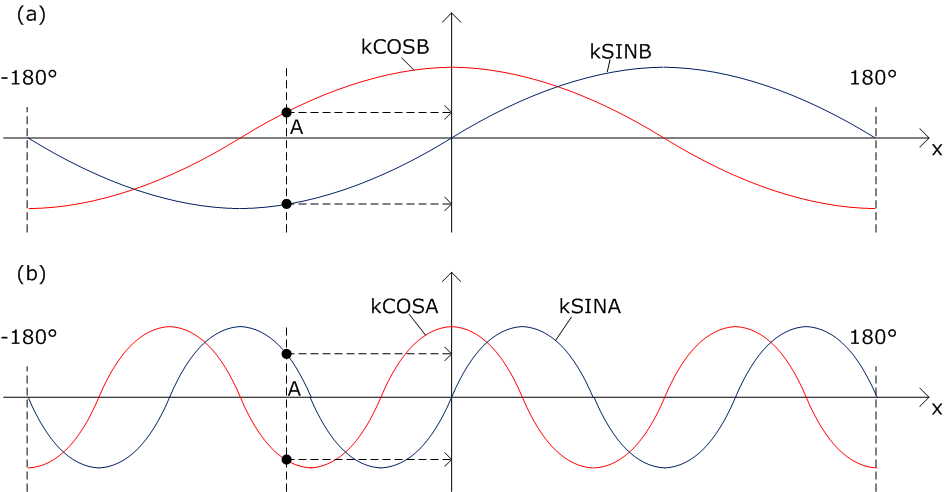
For greater accuracy and resolution a second, fine pair of coils is added, COSA and SINA. Their job is to deliver the additional accuracy and resolution. Fine sensor coils have a repeating sinusoidal coupling pattern, so on their own they only detect incremental position. To determine absolute position a pair of coarse coils, COSB and SINB, are also present, patterned for a single sinusoidal period or less of coupling along the measuring range. The processor IC detects both fine position from the COSA and SINA coils and coarse position from the COSB and SINB coils, and combines the results to yield a single, precise and accurate absolute position value reported to the host.
Type B Precision Linear and Type B Precision Rotary Sensors are recommended for new designs and are compatible with the CAM622 processor IC.
Precision Linear Sensors and Precision Rotary Sensors are available for the older CTU processor IC range including the CAM204, CAM312 and CAM502. Type 2 circuitry is used for longer linear sensors, while the slightly simpler Type 6 circuitry is used for shorter linear sensors and rotary ones. Please refer to sensor datasheets for compatible circuitry. In addition Axial Sensors are available for linear position measurement and allow the target to rotate freely about an axis pointing along the measuring direction. The CAM312 with Type 3 circuitry processes Axial Sensors.
Find out more with this introduction to our technology:
Sensor Design
Proven sensor PCB designs for customers to manufacture themselves for low cost and convenience
Read more Sensor Design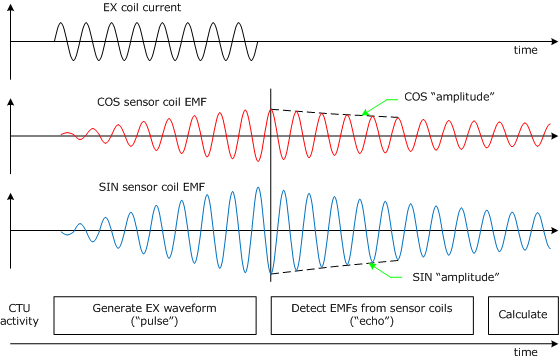
Interrogation
Pulse echo operation means accuracy without calibration, even with nearby metal
Read more Interrogation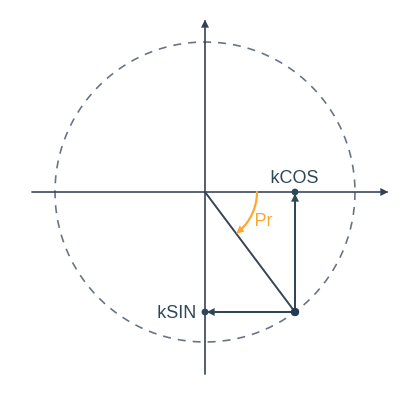
Position Calculation
Fully ratiometric and digital signal chain for precision and immunity
Read more Position Calculation
Comparison
How resonant inductive sensing measures up against traditional position sensors
Read more Comparison