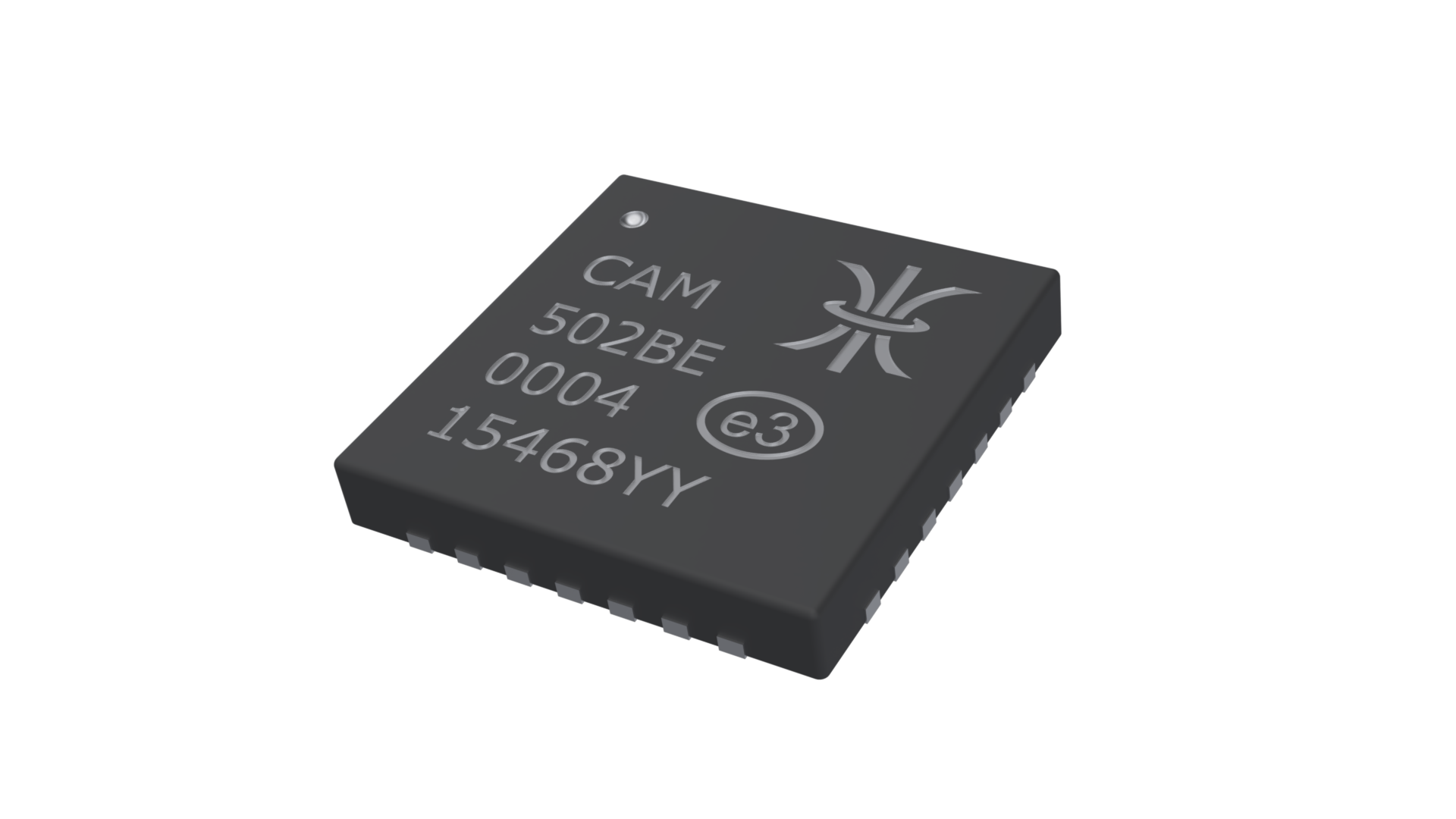
The CAM502 is a high-speed processor IC for resonant inductive position sensing. It can measure a single sensor at 5000 samples per second.
For most new applications the CAM622 is recommended instead. However the CAM502 can still be considered for processing linear sensors longer than about 300mm and when the CAM312’s update rate is insufficient.
Measurements can be synchronised to a host SPI interface so that results are delivered to the host with as small as possible Group Delay.
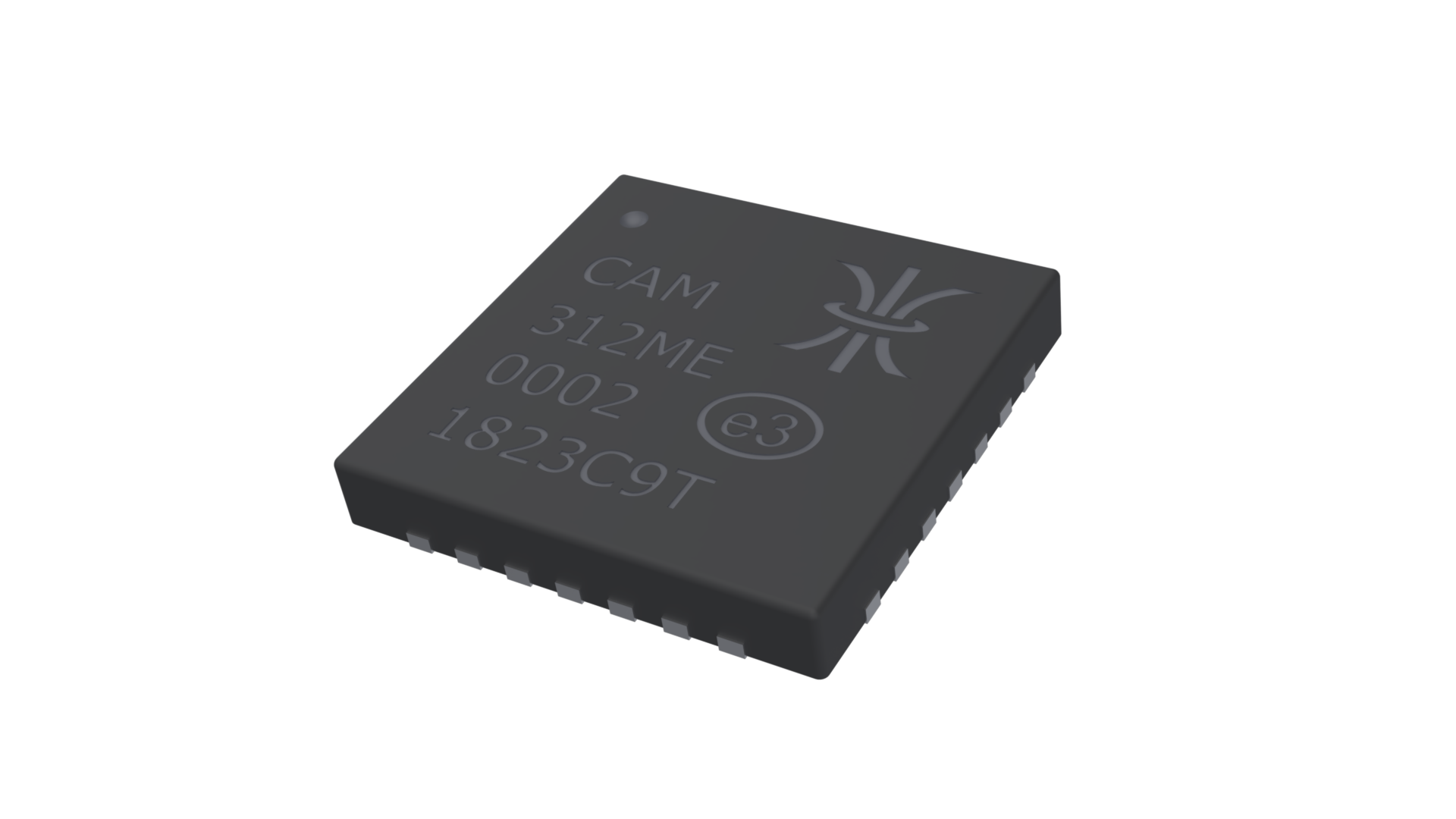
The CAM312 is a cost effective processor IC for resonant inductive position sensing. It can connect to and process up to two sensors, and reports results over an SPI interface.
For most new applications please consider the CAM622 first. However the CAM312 is still recommended for applications requiring low-power operation, for linear sensors above about 300mm and where two basic sensors are to be processed by a single IC.
Development boards are available for evaluation, prototyping and development of CAM312 based solutions. Find out more here
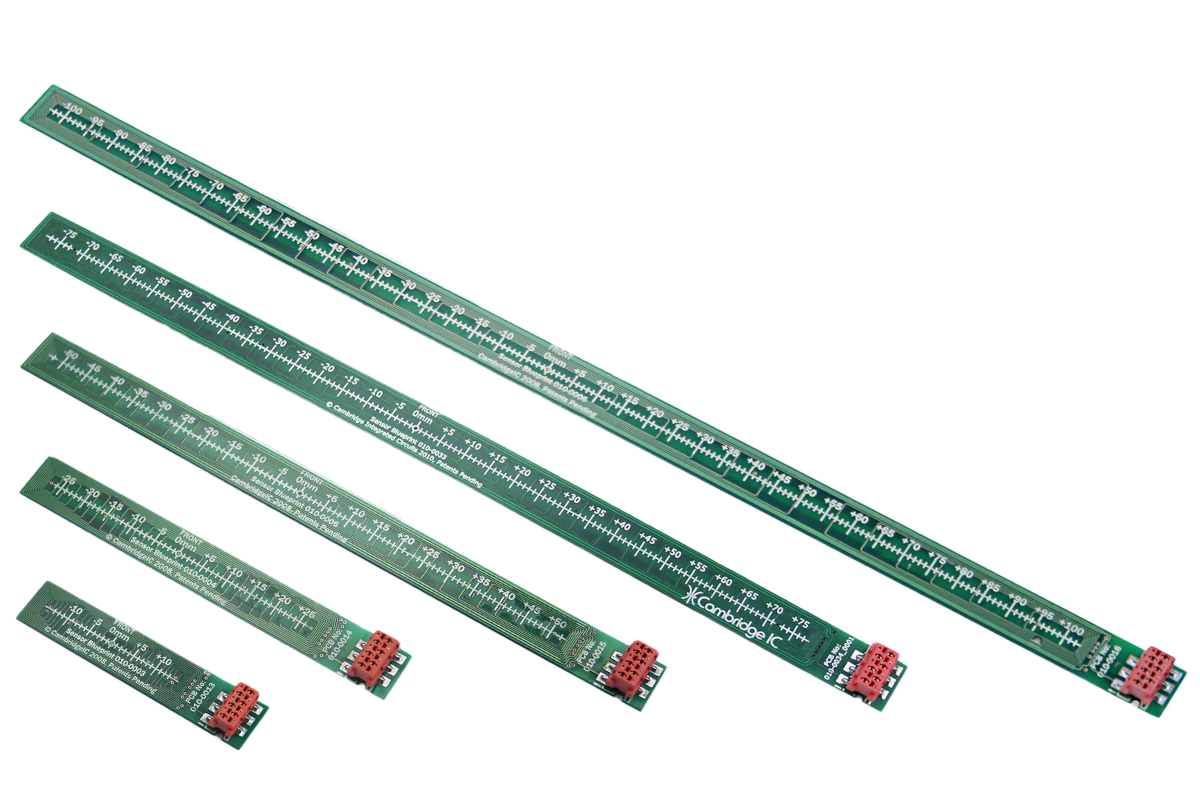
Basic linear sensors are robust and simple. Standard designs are available from 25mm to 300mm measuring length.
The basic linear sensor is a Type 1 sensor (find out more about how sensors are classified and what this means for CTU selection in our FAQ). A single CAM204 Central Tracking Unit (CTU) chip can operate up to 4 Type 1 sensors, including a mix of linear and rotary.
For new designs, customers should also consider a Type B Linear Sensor used together with its matching Type B Linear Target and the CAM622 processor. This is because the target is simpler, being built from a PCB, and occupies less space. The CAM622 procesor also offers dramatically higher speed and resolution than the CAM204 and CAM312.
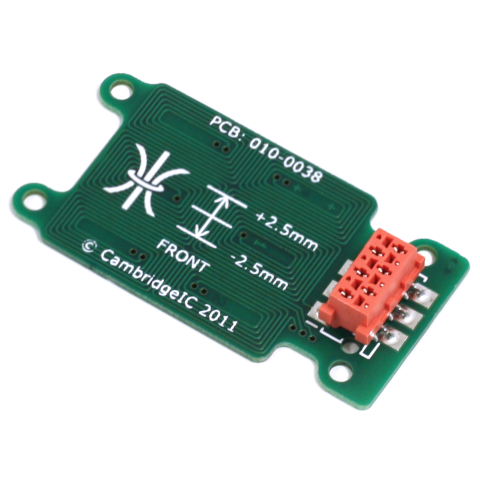
Short Stroke Linear sensors are built using conventional PCB technology and detect the position of a standard target without mechanical or electrical contact. They are robust, simple and tolerant of misalignment and large gaps.
Measuring Length is typically up to 6mm, although the target is detected over a much greater (but non-linear) range.
The short stroke sensor is a Type 4 sensor (find out more about how sensors are classified and what this means for CTU selection in our FAQ). The CAM204 Central Tracking Unit (CTU) chip can measure up to four Type 4 sensors and the CAM312 can measure up to 2 sensors. Specific development boards are available for testing (see below).
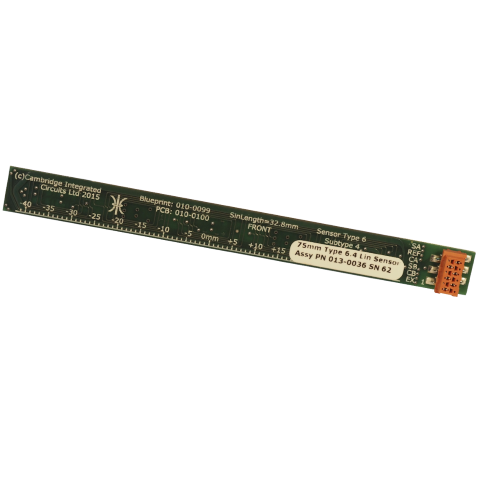
Precision linear sensors offer performance improvements over basic linear sensors. They do this with an additional “fine” set of sensor coils. This fine track delivers high precision and accuracy, while a coarse track delivers an absolute output.
The CTU chip connected to the sensor combines the outputs of both tracks so that the position it reports to the host is always absolute, precise and accurate.
Precision linear sensors can be Type 2 or Type 6 sensors (find out more about how sensors are classified and what this means for CTU selection in our FAQ). Type 2 sensors offer greater measuring range than Type 6.A single CAM204 CTU chip can operate up to two Type 6 sensors, including a mix of linear and rotary. The CAM204 can operate a single Type 2 sensor.
For new designs, customers should also consider a Type B Linear Sensor used together with its matching Type B Linear Target and the CAM622 processor. This is because the target is simpler, being built from a PCB, and occupies less space. The CAM622 procesor also offers dramatically higher speed and resolution than the CAM204 and CAM312.
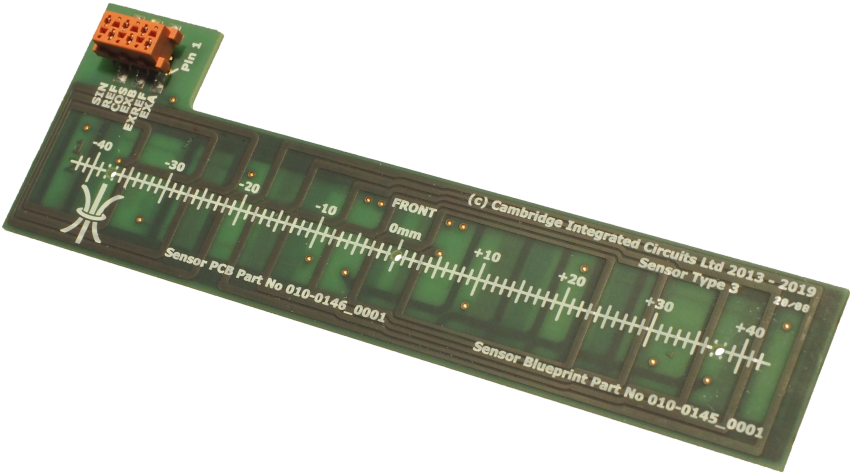
Axial linear sensors measure the position of a target which is allowed to rotate about the axis of measurement. This configuration suits applications where the moving part’s rotation can not be constrained, such as float level sensors, variable area flow meters and syringe plunger position measurement.
Made with a conventional PCB process, they are durable, compact and tolerant of misalignment between target and sensor, as well as large gaps. The large gaps allow sensor and target to be encapsulated in separate housings.
Axial Sensors are Type 3 (find out more about how sensors are classified and what this means for CTU selection in our FAQ) which use four coils – two of these excite the resonator in the target and all four detect signals coming back from the resonator, to be processed by a CAM312 IC.
The images here show (1) a 78mm Type 3.2 Axial Sensor Assembly, (2) an illustration of a float level sensing application using an air core target design and (3) an Axial Sensor working with a wound ferrite rod style target. Other target designs are possible – see datasheet for options.
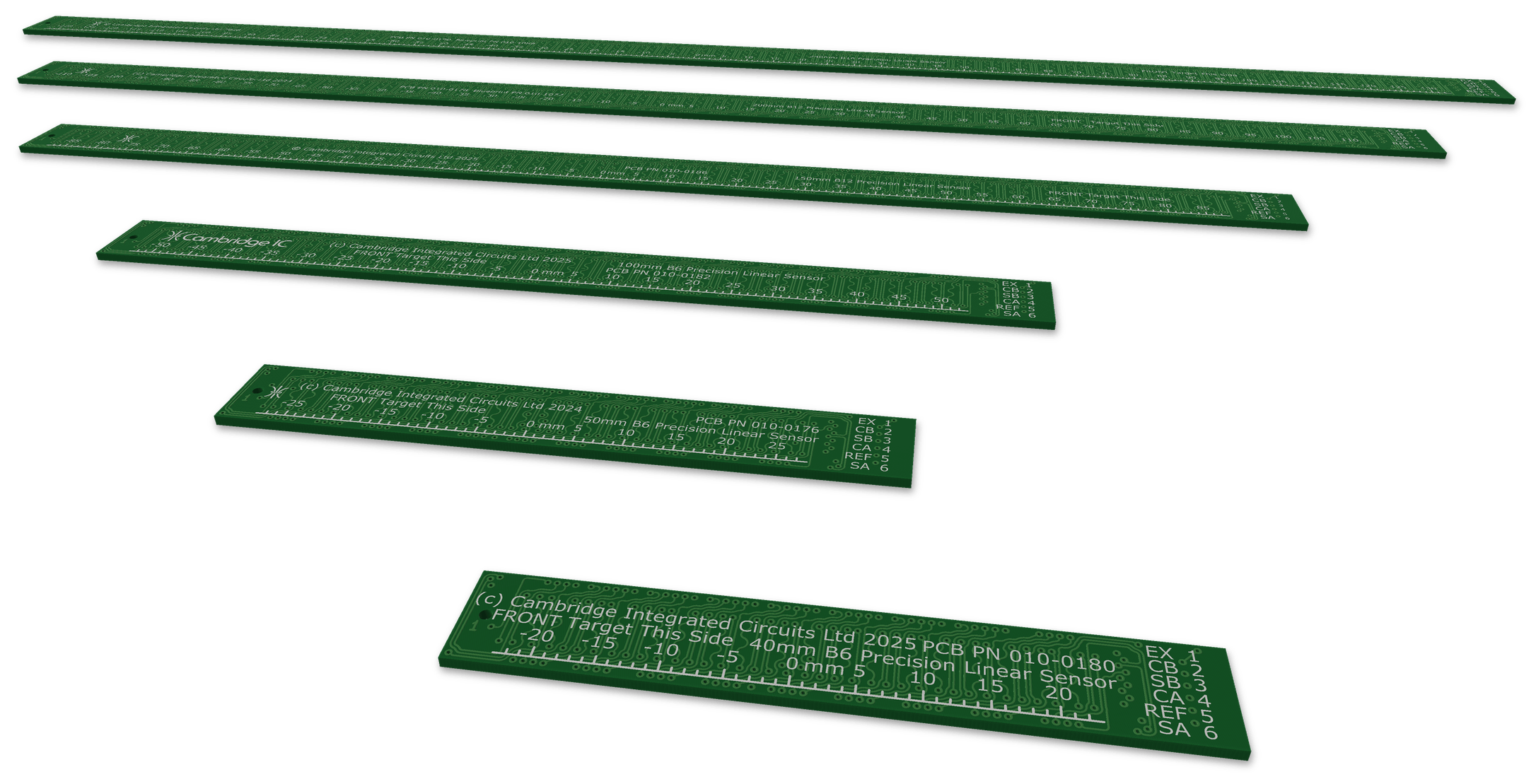
Type B sensors work only with the CAM622. Both sensors and targets are built from PCBs for low cost, robustness and small size. Standard designs are available from 40mm to 240mm measuring length.
Type B sensors detect the linear position of their matching Type B Linear Target.
Sensors include fine coils for precise measurement and coarse coils to establish absolute position. The sinusoidal pitch of the fine sensor coils is 20mm. The sinusoidal pitch of the coarse sensor coils is 6, 12 or 16 (the sensor’s “Subtype”), increasing with measuring length. There is less than one sinusoidal period of coarse coil along the sensor’s measuring length, so that the CAM622 can always establish absolute position.
Type B Linear Sensors and their Targets can be tightly integrated with metal parts in a customer’s product. Screening material allows them to fit in as little as a 3mm gap between parallel aluminum parts. Please see the application note available at the link below for more details.
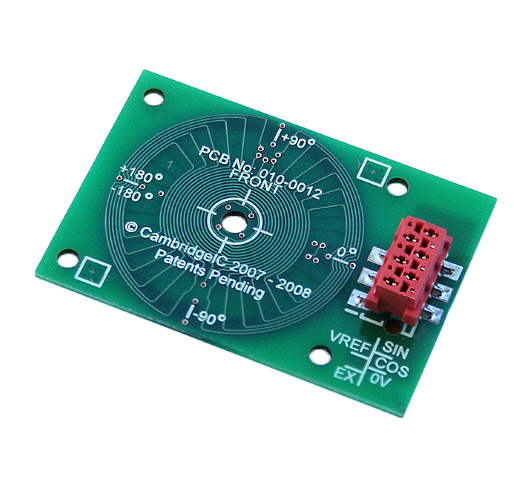
This basic range of rotary sensors is available in different diameters and measures the angle of a target at up to 12mm gap. Used on end shaft, in conjunction with a CTU chip, the system reports full absolute angular position over 360°.
The basic rotary sensor is a Type 1 sensor (find out more about how sensors are classified and what this means for CTU selection in our FAQ). A single CAM204 Central Tracking Unit (CTU) chip can operate up to 4 Type 1 sensors, including a mix of linear and rotary.
Basic rotary sensors are available in 25mm, 36mm and 50mm diameters.
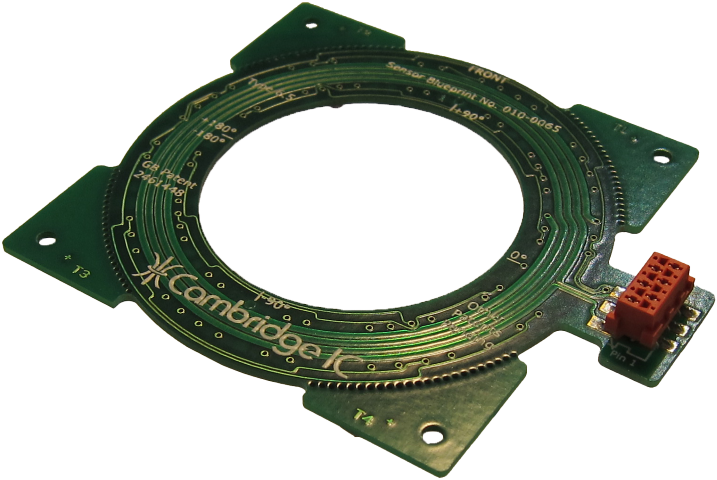
This range of rotary sensors is for precision angle measurement over a full 360° of rotation. Sensors and targets both include large central holes that allow a shaft to pass through them, and have a balanced design for immunity to misalignment.
Precision rotary sensors are type 6 sensors (find out more about how sensors are classified and what this means for CTU selection in our FAQ).
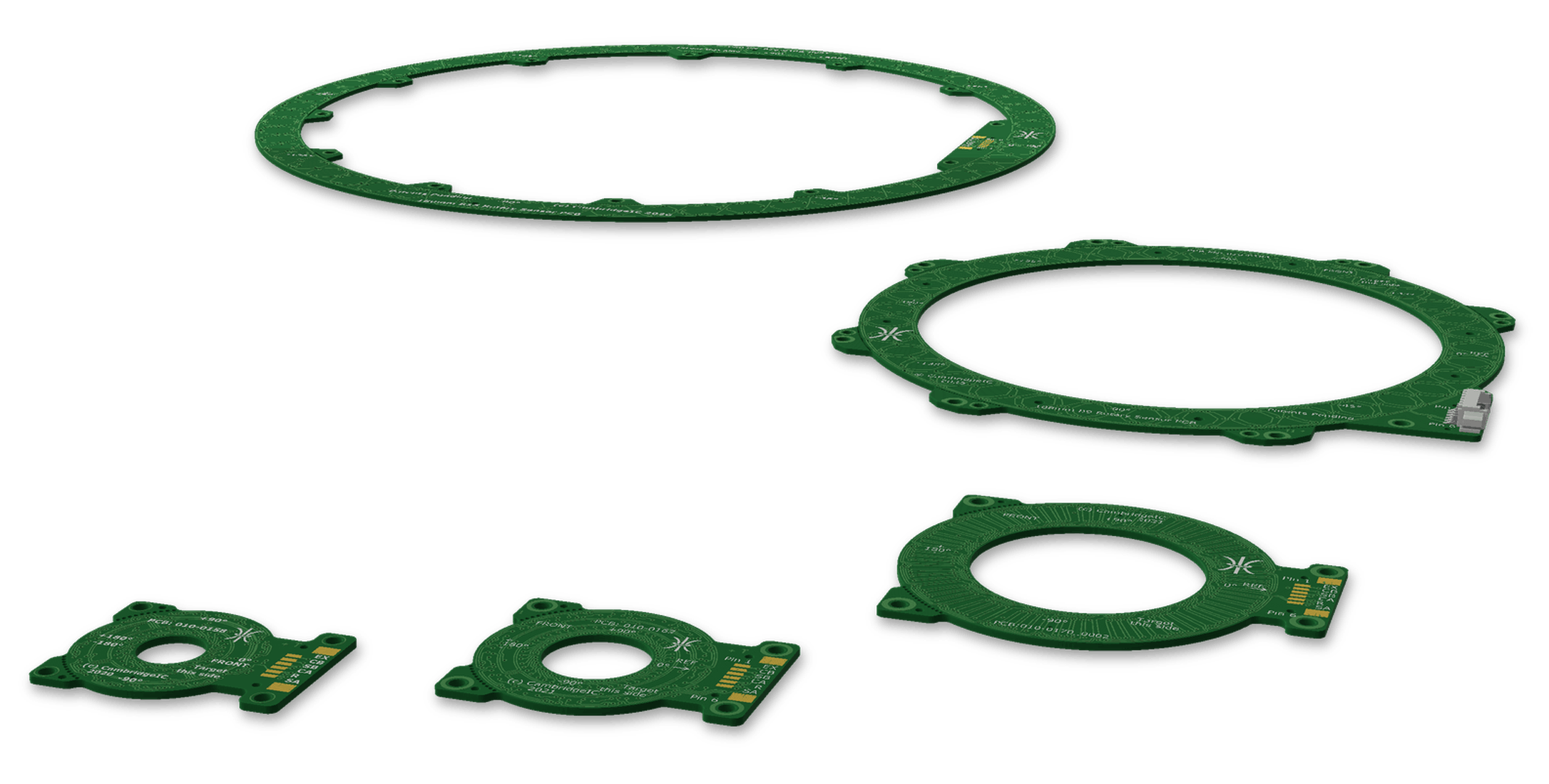
Type B sensors work only with the CAM622. They are for precise absolute angle measurement over a full 360° of rotation. Sensors and targets are both built from PCBs for low cost, robustness and small size.
Type B sensors detect the relative angle of the matching Type B Rotary Targets. Sensors and targets both include large central holes that allow a shaft to pass through them, and have a balanced design for immunity to misalignment.
Sensors include fine coils for precise angle measurement. These repeat 3 or 5 times around a circle (the sensor’s “Subtype”). A “B3” sensor means it is Type B and has a Subtype of 3. Sensors also include coarse coils to establish absolute position.
