
CambridgeIC has developed a new 180mm B15 Rotary Sensor and matching target for precise and accurate angle sensing. Both the sensor and target have a large centre hole that accommodates a rotating shaft of up to 156mm diameter.
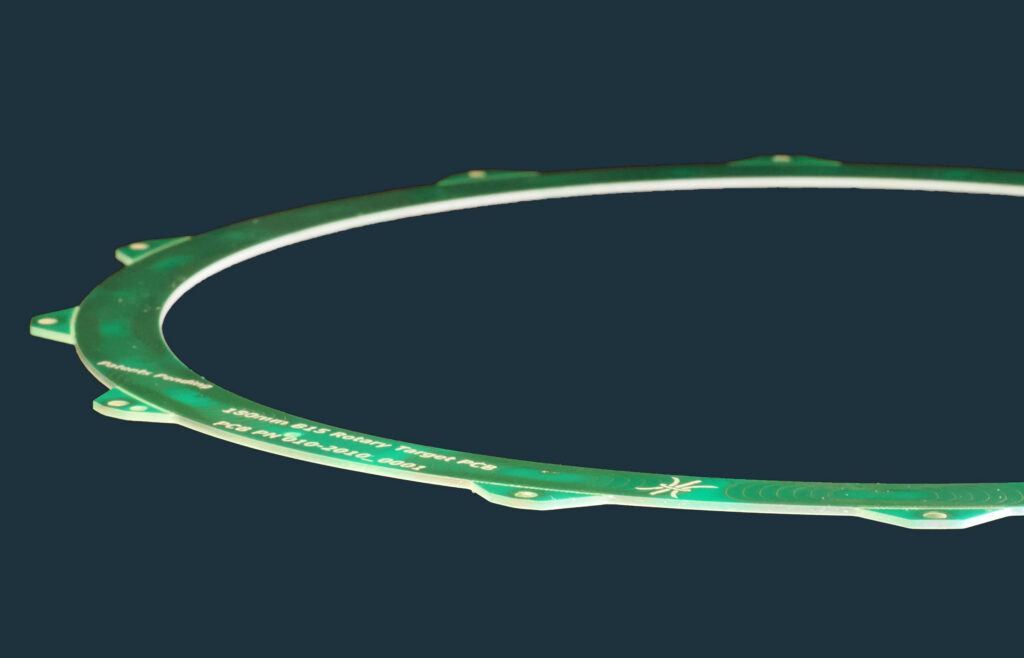
Like the smaller sensors in the Type B Rotary Sensor family, the sensor and target comprise coils printed on a PCB to CambridgeIC’s designs. Customers use these designs to build production parts themselves, to yield a precise, accurate, robust, environmentally immune angle sensing solution. Sensors work with CambridgeIC’s CAM622 processor, allowing customers to deeply integrate angle sensing within their machines.
The matching 180mm B15 Rotary target illustrated above is mounted on the rotating part. The sensor detects its angle using resonant inductive sensing technology without contact, and at a gap of between 0.5mm and 4mm.
When aligned at 1mm gap, the CAM622 reports position to a host device with 17.4 bits of noise free resolution. This is a true noise free figure, based on 0.002° peak to peak noise with default CAM622 motion filter settings. Many suppliers quote interface resolution instead, which for the CAM622 would be 32 bits.
Linearity error is less than ±0.01° when aligned at 1mm gap. This only increases to ±0.023° when gap is allowed to vary up to 4mm, radial misalignment up to 0.5mm and tilt up to 0.1°. This accuracy and tolerance to misalignment come from the inherent balance and quality of the designs, and the precision of PCB fabrication. This in turn makes the sensor and target easy to install, with no precise alignment or calibration necessary.
The sensor and target coil portions are only 10mm wide radially, yet they give a full absolute measurement. Each is built on a 1mm thick PCB, so with the minimum 0.5mm gap they occupy a total thickness of only 2.5mm.
The CAM622’s interface options include:
- SPI
- Quadrature ABN interface, configurable up to 65536 edges per revolution
- BiSS (BiSS is a trademark of iC-Haus GmbH)
- SENT
Applications include:
- High-speed closed-loop motion control
- Valve position sensing
- Direct drive torque motors
- Replacement of optical encoders
- Reduce cost
- Improve robustness and environmental immunity
- Replacement of magnetic position encoders
- Eliminate the magnetised target, which can attract swarf and is expensive
- Improve immunity to magnetic fields from a nearby motor
- Reduce the space envelope required for a full absolute angle measurement
For evaluation, select a Type B Rotary Sensor, its matching Type B Rotary Target and a CAM622 MultiComms Bundle, and connect to a PC running CambridgeIC’s CAM622 Read Position Application.
Please contact us for more information or to purchase samples.
Visit us at SPS 2026 in Nuremberg from November 24 – 26 to see the new sensor and discuss applications! We are exhibiting with MEV in Hall 4, Booth 174.
CambridgeIC, founded in 2007, develops processor ICs for resonant inductive sensing technology. The team has been pioneering this technology since 1994 and today serves a wide range of customers in industrial, medical, and automotive applications, including market leaders in their fields.